Showing posts with label free market. Show all posts

Monday, April 13, 2015

Did Korea's Economic Development Require State Protection?

A common argument that is often brought up to argue against free market capitalism is Korea's economic development. Many argue that despite the fact that President Park Chung-hee was a dictator, one thing that people cannot argue against is the economic development that Korea enjoyed under his 17-year-long rule.

Specifically, what those people are usually referring to is the series of protections, quotas, tariffs, and subsidies that President Park had given to what were then nascent chaebol companies.

One such defender of that point of view is Professor Ha-joon Chang, an economics professor at the University of Cambridge, and the author of such books as Bad Samaritans, Kicking Away The Ladder, and 23 Things They Don't Tell You About Capitalism.

Professor Ha-joon Chang
Image Source

Much can be said about his books, and I plan to do so in the future. For now, however, I will focus only on his defense of the infant industry argument, which is an idea that argues that emerging businesses and industries require government protection – in the form of tariffs, subsidies, and quotas – from their more entrenched competitors, particularly foreign competitors.

In that article that I linked earlier from The Independent, Professor Chang compares nascent industries to his six-year-old child. If this weren't a cringe-worthy moment of stupidity and/or academic dishonesty, I don't know what is.

Image Source

Moving on, in Bad Samaritans, Professor Chang makes the argument that Korea's economy did not develop because of neo-liberal economic policies, but rather due to heavy government involvement in the economy. There is no question that that is true.

There is also no question that Korea's rapid economic growth was nothing short of miraculous. There is a reason that it is often referred to as the Miracle on the Han River. But is that proof that protectionism was what allowed Korea's economy to develop so quickly? Well, that's quite hard to confirm considering the fact that Singapore and Hong Kong, which practised freer trade policies, went through much quicker and greater economic development.

“But they are city-states; they cannot be compared to a country that is so much bigger like Korea,” I often hear people say.

Fine, fair enough. Then one has to wonder about China and India. Both countries are much bigger than Korea and their economies grew much more quickly after they began to liberalize their respective economies (see here and here).

Of course, this is certainly not to say that government controls and economic programs are non-existent in Hong Kong or Singapore or China or India. They are not free market economies. But they have shown that freer markets do lead to greater growth.

Image Source

Another point that Professor Chang does not mention is that subsidization and other forms of government protections do not guarantee economic survival or development in any way, stretch, or form.

Yes, Korea is an example of an economic success story. However, we also have to look at other examples where protecting infant industries were not successful. For example, African cotton farmers want their governments to end the subsidies programs for their respective national industries so that they can finally compete in the international market; and which African country's economic development could ever compare with Korea's economic growth?

The problems of protecting infant industries are not limited to African countries. In the United States, despite the government's efforts to prop up Solyndra, a company that specialized in manufacturing solar cells, with up to US$535 million of taxpayers' money, the company still declared bankruptcy.

Similar examples can be found in Korea, too. Samsung was certainly one of the chaebol conglomerates that the Korean government helped to protect and nurture. However, Samsung is not the only business that got so much love from the government. Another industry that has gotten a lot of love from the Korean government is the rice industry. So why has Samsung become an internationally well-known name but there isn't a single Korean food-producing company that is as well-known outside of Korea?

In other words, no amount of subsidies or trade protections ever seems to be able to prevent what was always doomed to fail from failing.

So what does Korea owe its economic success to? That is a difficult question to answer; much more difficult than Professor Chang would like for his readers to believe. It's certainly not free market economics. As Professor Chang has shown, the Korean government has been heavily involved in Korea's economy. But as I have shown, freer markets like Hong Kong and Singapore have grown more quickly than Korea and subsidies do not guarantee success.

Though that specific question may be harder to answer, what is much easier to answer is that Korea's economy did not develop because of the government's protections, subsidies, and overall involvement in the economy, but rather in spite of them.

Image Source

Thursday, June 27, 2013

The Minimum Wage: It doesn't help, but actually hurts the poor

On June 15th 2013, the Hankyoreh reported that a group of part-time workers held a protest outside the Korea Employers’ Federation building in Seoul’s Mapo district during the Minimum Wage Committee’s meeting. The protesters called for a minimum wage of ₩10,000 per hour (about US$9.50).

Source: http://english.hani.co.kr/arti/english_edition/e_national/591936.html

The arguments that are laid out to increase minimum wage rates are all too familiar: low-income earners cannot keep pace with the rate of inflation, people must be guaranteed a livable wage so that they may “live with dignity,” etc.

Although difficult to not sympathize with, these arguments are, in effect, emotional arguments, which, when studied rationally, people will be able to see that they do not achieve their intended goals. In fact, these laws, when put into effect, actually make things worse, especially for those that the laws were designed to help in the first place.

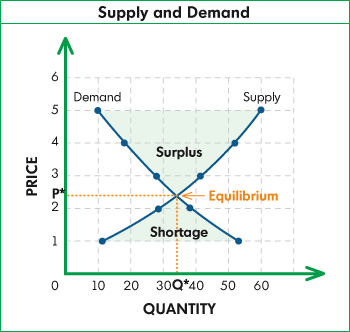
One of the first lessons that one learns in Basic Economics is that the price of goods and services is determined by the level of supply and demand. At some point, the level of supply of and demand for goods meet and this point is known as the equilibrium point. The equilibrium point, ceteris paribus, determines the price at which sellers are willing to supply goods and consumers are willing to pay for goods. If the price is artificially set above the equilibrium point, then suppliers wanting to maximize profits will produce more of the goods but the consumers will not be able to afford them. This leads to a surplus of unsold goods. On the other hand, if the price is artificially set below the equilibrium point, then suppliers who feel that they might not even be able to recover their initial investments will produce less of the goods whereas the consumers, who can now afford more, will demand for more of the goods. This leads to a shortage of goods.

Obligatory economic graph showing supply and demand curves and the equilibrium point
Source:  http://realintent.org/wp-content/uploads/2013/04/supplydemand-graph.gif

This seems obvious enough and most people can recognize this supply-demand mechanism. This mechanism is what determines the price of everything, including the price of labor.

We don't particularly enjoy thinking of ourselves as economic commodities. We are, after all, human beings; each with our own sets of dreams, hopes, and fears. However, labor is indeed an economic commodity and what we call “wages” is, in fact, the cost of labor.

Going back to the supply-demand mechanism, when we look at a neat economic chart, it becomes very clear that a minimum (known as a price floor in economic parlance) leads to a surplus of unsold labor aka more unemployed people than there would be had there been market-determined wage rates instead.

I shall attempt to explain how this surplus comes about.

Some economists will argue that when wages are artificially raised, businesses will simply ‘shift’ the increased costs to consumers in the form of higher prices, which leads to a general increase in the price of most, if not all, commodities. This is a type cost-push inflation argument. This does NOT generally occur.

Businesses do raise prices when faced with inflation (to explain what inflation really is and its causes requires another very long essay of its own) but for the most part, businesses do not like to raise prices. Raising prices tends to make businesses less competitive, especially if they have to compete with foreign imports or operate within highly saturated markets.

Cost-push inflation is a theory proposed by some economists who subscribe to the idea that businesses maximize their profits by charging highest possible prices (within limits that allow businesses to maximize profits while at the same time remain competitive). This is a fallacy. In reality, businesses do not maximize profits by charging highest possible prices. They do so by minimizing costs.

Let's take Starbucks Coffee, Angel-in-Us Coffee, and Tom N Tom’s Coffee for example. All three businesses sell nearly identical goods and services. Should any one of those businesses raises its prices, there are other coffee franchises (not to mention the thousands of other cafes that exist) that customers can choose to patronize instead. Therefore, in order to remain competitive and maximize profits, instead of charging highest possible prices, businesses have to minimize production costs via wholesale buying of supplies and equipment, outsourcing transportation needs, etc.

Wholesale looks as boring as it sounds
Source: http://www.hahebo.com/h4_hahebo/upload/3019opkoper_opkoper.jpg?w=575&h=252&c=C&zw=0

So let’s assume that the protesters get what they want and the minimum wage is raised. Would this affect large corporations like Starbucks or Angel-in-Us? Yes, it would. Unless heavily dependent on machine labor, most businesses almost always cite labor as its biggest cost. However, these large corporations are very efficient businesses.

(By “efficient,” I don't mean that large corporations are somehow more hardworking than small businesses. I mean it strictly in the economic sense of the word, ie. economies of scale aka ability to minimize production costs.)

This means that large corporations can absorb higher wage rates into their production costs and still maintain very high profit margins without having to lay off a significant number of their workers or charge significantly higher prices to their customers. The same cannot be said of smaller, less efficient businesses like, say, your local fair trade-supporting organic coffee shop . That less efficient coffee shop will have no choice but to lay off workers in order to stay competitive against corporate competitors such as Starbucks; and if that option is unavailable, worst-case scenario, it will have to go out of business.

In short, the minimum wage affects small businesses negatively more than they do large corporations. By forcing businesses to pay a minimum wage that might be higher than what businesses can afford, the government will cause more unemployment via foreclosures of smaller marginal businesses and thus compel more people to rely on government handouts, which is the exact opposite of the these laws’ intended objectives.

Unfortunately, the story doesn't end there. As a result of the wage increase, people who work in corporations will be relatively well-off and union workers, whose union bosses always make sure that their members’ wages are almost always placed above the average Consumer Price Index, will also be relatively well-off.

But what about marginal workers? Who are marginal workers? Take your pick: high school dropouts, college dropouts, teen moms, ethnic minorities, immigrants, the disabled, juvenile delinquents, parolees, etc.

For reasons that are too numerous to speculate, whether the reasons are justifiable or not, businesses tend to avoid hiring these workers because of the risks that are perceived to be associated with them. This means that even under normal circumstances, businesses are less willing to employ them and even if businesses do employ them, they would only do so on a lower-than-market wage rate. The minimum wage would, in effect, artificially inflate the cost of hiring such risky marginal workers for businesses, which would transform these marginal workers into unemployable workers, thus inadvertently causing the poor to stay poor. Again, this is the exact opposite of these laws’ intended objectives.

Passing laws with unintended consequences since Day 1
Source: http://www1.pictures.zimbio.com/gi/Canadian+Prime+Minister+Stephen+Harper+Visits+twU0KcYTOmhl.jpg

So why do people like those protesters support such laws? There are a number of reasons.

Firstly, people oftentimes make the mistake of equating wealth with money. Wealth is not, in fact, money. Real wealth, all mushiness aside, are the goods and services that we can buy. Money is merely the medium of exchange that is used to buy these goods and services. People make the mistake of thinking that the more money we have, the wealthier we are but this is simply not true unless there is a proportionally greater increase in the production of goods and services that we can buy with that increased income.

If we have more money but still have the same set of goods and services that we can buy, yes, we will FEEL richer but in the long-run, our increased income will not be able to buy more than what reality allows us to buy. In fact, due to inflationary pressures, our purchasing power will, at best, stay the same or, at worst, depreciate.

Secondly, it is my belief that people’s emotional faculties are more highly developed than their rational faculties. History has shown repeatedly that we cannot eradicate poverty by legislative fiat or just by simply throwing money at the poor. Governments have pursued anti-poverty programs for as long as governments have been around and each and every last one of them has failed.  Raising the minimum wage in the past did nothing to alleviate poverty.  There is no reason to believe that raising the hourly minimum wage to ₩10,000 or ₩1,000,000 will alleviate poverty either.

Again, we're not talking about the price of diamonds or fancy sports cars. Those are just things. We're talking about ourselves – humanity – in all our beauty, ugliness, glory, shame, triumphs, failures, joys, sorrows, hopes, fears, etc. In our pride and vanity, both deservingly and undeservingly, we become emotional and spit out half-baked pseudo-economic statements such as “the market-determined wage rate is too low in a free market.”

At the end of the day, labor, which is merely one of the near infinite number of goods and services that we buy and sell, no matter how personal it is to us, is merely yet another economic commodity that must obey the fundamental rule of supply and demand.

I understand where the desire for the minimum wage comes from. We wish to improve our own standard of living and also help the poor. By supporting and enacting these policies, however, we will only hurt ourselves. In order to avoid hurting our own economic interests, we ought to be as rational as possible and instead of judging government policies based on their intentions, we ought to judge them based on their actual results.

If we really wish to improve our economic condition and standard of living, instead of trying to artificially raise wages by legislative fiat, we should have the government intrude less on businesses and leave the free market, aka us, to function on its own independent will.

Source: http://www.aei-ideas.org/wp-content/uploads/2013/02/PayneMinWage.jpg