Showing posts with label inflation. Show all posts

Monday, July 11, 2016

What Going Cashless Could Mean

A few months ago, news broke that the Korean government plans to eliminate coins from its money supply by 2020. However, eliminating coins is not the end goal in and of itself. The ultimate goal is to eventually also phase out paper money. However, there is no set date for that yet.

At first glance, this makes sense. More and more people are using debit cards, credit cards, various smartphone apps such as Samsung Pay and Kakao Pay, as well as virtual cryptocurrencies such as Bitcoin (though Bitcoin does not seem to have become mainstream in Korea just yet) to make financial transactions. Considering the overall social trend that we are seeing in Korea unfold before our very eyes, it is understandable when the Korean government says that eliminating coins from the overall money supply would be able to help it reduce minting costs, which is about ₩60 billion (US$52.1 million) per year.

Although it is likely that the Korean government still has a positive seigniorage rate -- the profit made by a government by issuing currency, especially the difference between the face value of coins and their production costs -- in the long term, eliminating coins would be more profitable because of inflationary pressures that devalue money.

So going cashless certainly has benefits. An added bonus that comes with the elimination of cash is that it would severely inconvenience those engaged in criminal activity. As more and more people use cards, physical or virtual, to make and/or receive payments, it would become much harder for activities like tax evasion, gambling, money laundering, terrorism financing, human trafficking, and the drugs trade to go unnoticed by the government. And in Korea's case, it would help the government to better monitor the clandestine flow of money into North Korea, which is no small matter!


Image Source

However, there is another reason, a rather big reason, that the government prefers a cashless society; and it is one that is seldom talked about by those outside of groups that focus on cryptocurrencies or economics in general. The reason is that a cashless society would make it much easier for the central bank, in Korea's case that being the Bank of Korea, in tandem with the government, to potentially impose negative interest rates.


What are Negative Interest Rates?

Central banks all over the world are tasked with maintaining a certain level of stability in each country's financial system. Among the tools that central banks possess, nothing is as powerful as their ability to increase or decrease the discount rate, which is the interest rate charged to commercial banks and other depository institutions for loans received from the central bank.


So, for example, if a central bank decreases the discount rate, which is what is typically being done around the world these days, it would make it cheaper for commercial banks to borrow money from the central bank. In turn, the commercial banks would be able to pass on those savings to their customers -- you and me -- in the form of lower interest rates charged on things like auto loans or mortgage loans.

This would compel individuals to borrow and spend more money. That way, a stagnant economy would get the boost that it needs and it might be able to stave off or perhaps even recover from a recession.

Similarly, if an economy is overheating -- witnessing dangerously high inflation rates -- the central bank will increase the discount rate, which would then have a domino effect of making it more costly for people to borrow money, which would then help to cool the economy.

At least that's the theory anyway. But what happens if the theory doesn't match reality?


Image Source

What happens if an economy doesn't experience growth despite the fact that interest rates are kept close to zero? For example, interest rates in Japan have been kept at nearly zero for more than 20 years, but it has not helped Japan to escape from its deflationary trap. When we consider the fact that much of Korea's economy was modeled after Japan's economy (see here and here for more wonkish comparison) and also take into account that, like Japan, Korea has an aging population, the possibility of falling into a decades-long deflationary trap is not an unfounded fear.

As a result, more and more governments are now flirting with an idea that was once panned as being ridiculous -- negative interest rates. Basically, it's taking the idea of imposing lower interest rates to stimulate economic growth and injecting it with steroids.

The idea is that the central bank will go all in and impose a discount rate below zero percent for commercial banks. The idea is that if a central bank imposes a discount rate of, say, -0.5%, commercial banks would be less willing to park their money in the central bank where they would be charged money for doing so. So, instead, commercial banks may prefer to lend money to each other. The theory is that when more and more money circulates among commercial banks, then banks would more willingly lend money to their customers, which would in turn help to stimulate economic growth.


Does this mean that the Average Joe/Jane will have to pay to keep money in a bank?

That is a popular argument that many have made in regards to the negative interest rate. However, I think it is unlikely that commercial banks would actually do that. People who make that argument often neglect to look deeper into the very different relationship between central banks and commercial banks and the relationship between commercial banks and their customers.

Whereas the relationship between KB Kookmin Bank and me is one that can be characterized as a business/customer relationship, the same cannot be said of the relationship between Kookmin (or insert other banks here) and the the Bank of Korea. That is because central banks act much like regulators over their respective financial industries. In other words, consent is practically non-existent in the relationship between central and commercial banks. For good or for ill, central banks make the rules and regulations and in order to stay in business, commercial banks have to obey those rules.

It goes without saying that banks hold a lot of leverage over their customers, but no matter how powerful commercial and investment banks may be, there is one power they do not possess over their customers. They have no control over their customers' choices. For example, if Bank A charges their depositors an annual fee to keep their money in their bank, those depositors will more than likely look for other banks to save their money in where they won't have to pay such a fee. And Banks B and C and D and others will only be too happy to oblige.

That is why it is unlikely that commercial banks will somehow end up cannibalizing their customer base. Especially during periods of economic slowdown, market expansion might be a more practical strategy for long-term survival than profit maximization.

However, it does not change the fact that commercial banks would still be losing money because of the negative interest rates. So, they may partially push those costs to their customers by other means such as higher overdraft fees or eliminating free account transfers. So there is a chance that regular bank depositors might end up having to pay additional hidden fees, but being directly charged for saving money in a bank account sounds like a tinfoil hat conspiracy theory.


Image Source


What does this have to do with a cashless society?

The theory behind negative interest rates is almost sound. Incentives are important and when there is no incentive to save -- in fact, if there is every incentive to spend -- people will spend more money, which would help to stimulate economic growth. However, there is a problem with the theory. It depends entirely on the assumption that human beings think and act like Homo Economicus. The problem is that Homo Economicus does not exist.


Homo Economicus is all about maximizing one's economic utility and is aware of all publicly known information and responds accordingly. So for example, if the government taxes kale at 100% but taxes candy bars at only 10%, and assuming that they are the only two things that anyone can buy and depending on the utils that Homo Economicus derives from kale and candy bars, respectively, there is a very good chance that Homo Economicus would buy only candy bars. None of that describes a typical human being.

Human beings do not possess all publicly known information. Everyone suffers from asymmetric information from one degree to another, we are all biased, and we all tend to act emotionally. And one of the most powerful emotions that dictates how people think and act is fear.


Image Source

Theoretically, a negative interest rate will drive individuals to make the necessary cost-benefit analysis and decide that spending one's money would be more profitable than saving money at zero percent interest. However, the theory discounts humans' fear of the future. Though we do not possess all publicly known information, we are a species that is aware of our own frailty and mortality. Barring any unforeseen circumstances that could potentially snuff out our lives at any given moment, we will all some day grow old. Our bodies will become weak, our minds will become feeble, and we will all die. That is ultimately why we save our money and not spend every penny that comes our way (if you do spend your money like this, STOP IT!).

Negative interest rates could potentially wreak havoc on people's retirement plans. If the interest rate is above zero, we can save our money with the full knowledge that the balance that we end up with at the time of our retirement will be greater than the principal that we started out with (assuming that our savings are not canceled out by inflation). Unlike interest rates that can be changed at will, however, assuming there is no sudden medical breakthrough that will cure everything, the aging process does not change. So even if the interest rate is at zero percent, it will not change the fact that we still have to plan for retirement. But zero percent compounded for X years is still zero. That means that in order to reach our targeted savings goal for our retirement, we need to save more money than we would have to had the interest rate been above zero.

This is one of the possible reasons that might explain the ineffectiveness of keeping interest rates low.

So especially in aging societies like Korea and Japan, it is possible that imposing negative interest rates could lead to drastic unintended consequences (not to mention the fact that lower profit margins that negative interest rates would impose on banks in general could drive a lot of smaller banks out of business, thus inadvertently exacerbating the "too big to fail" phenomenon).

So imagine what you would do if you were planning for retirement but the bank is basically telling you that it will do nothing more than simply hold your money. What would you do? The more risk averse among us would still likely keep our money in our bank accounts despite the zero percent interest. After all, the money in the banks are insured by the government. But for those who are more prone to taking risks for whatever reason, it is likely that they will pull their money out of the bank and invest it in something that will give them a greater long-term yield. That is why so many people who can afford to do so buy property (though everyone should always keep an eye out for economic bubbles).

But if enough people pulled their money out of their banks to look for greener pastures, couldn't that lead to a bank run and wouldn't that be catastrophic? Yes, it would certainly be catastrophic. But what if there were no cash to withdraw from the banks to begin with? When there is no physical money that you can hold in your hands or literally stuff under your mattress, when the only money that you can use is all digital e-money and, unlike cryptocurrencies like Bitcoin, it can all be tracked by the central bank, then you literally cannot flee from the banks. Or at least it would be really hard to do so.


Image Source

That is because it would become much easier for the government to "direct" people from deciding against "hoarding" their money upon the imposition of a negative interest rate after cash has been eliminated. To explain, in order to have better returns, individuals may desire to take their money out of their bank accounts and invest it in private asset markets such as property or what have you. However, unlike banks, other private asset markets are not guaranteed by the state, and thus not safe for investors. At least not as safe as banks. That way, there will be incentive for people who prefer safety and risk-free investments to keep their money invested in state-guaranteed banknotes, even if all of those banknotes are purely digital.

In other words, a cashless society transfers absolute control of the money supply to the central bank. Combine that with negative interest rates and the central banks have the perfect mix of ingredients necessary to incentivize spending, disincentivize savings, AND prevent bank runs that could offset the stimulative goals of the negative interest rate. Theoretically, assuming everything goes according to plan, the macroeconomic outlook will become less dire and might be a winning strategy to overcome negative economic growth. But what will that do to individuals' savings? How will this effect retirement plans?


So why not go cashless from the get go?

Like the case in Germany, though many people prefer to use other methods of payment, cash still has a special place in everyone's hearts for various reasons (see here, here, here, here, and here).


So, a sudden abandonment of cash would be met with great resistance. It would make a lot more sense to gradually acclimate the public to going cashless.

The government has stated that people will be issued special cards for them to store their e-change. For example, if someone buys ₩9,500 worth of goods and handed over a ₩10,000 note to the cashier, instead of receiving a ₩500 coin as is done right now, the cashier would digitally wire that ₩500 worth of change to the card that the customer carries. This is perfect in many ways. That is because eventually, all the change that gets digitally wired to individuals' cards will begin to accumulate over time and once that happens, that accumulated money in people's cards will be used for transactions side by side with paper money (for as long as paper money is still circulated).

This means that the continued use of e-money could be further incentivized. Doing so would just be a matter of imagination. For example, the government could provide a favorable rate environment for e-money, or by an enticing exchange rate for swapping out of paper money for e-money via credit or point systems or special offers in partnership with Korean conglomerates.

Combine that with a a steady campaign to stigmatize the use of paper money -- as has already been done throughout Europe -- and the Korean government would be able to gradually shift toward a cashless society while facing minimal resistance. It's actually quite brilliant.


What it would mean to live in a cashless society

As I mentioned earlier, a cashless society could wreak havoc on people's retirement plans. And this is no small matter especially when we take into account how much debt the average Korean household has. 


There are other possible outcomes that could arise from going cashless. For one thing, a cashless society would certainly reduce privacy for the average person as our money could easily be tracked, thus making it incredibly difficult to hide our money from the Tax Man. However, it is not just the government that people will have to worry about. Once e-money is "printed" by the government and administered to the general public by private financial institutes, it could become much easier for our spending habits and history to be tracked by others such as insurance companies and marketers.

As usual, the rich will still be able to benefit. They can buy anonymity via shell companies or charities. However, for average people, anonymity would be a thing of the past. However, those who would be hit most are those who currently do not have bank accounts because of poor credit scores. Once cash becomes a thing of the past and they are still barred from banks because of their poor credit scores, their lives could become much more difficult. It would not be a stretch to conclude that this could potentially exacerbate the wealth gap.


If you're rich
Image Source

Further, it could also make life miserable for those who are deemed immoral by societal standards. Take the porn industry for example. In 2014, it was reported that Chase Bank had shut down a number of bank accounts that were discovered to have been used by porn actors. Porn is already illegal in Korea and those who are apprehended are usually prosecuted to the fullest extent of the law. Pornographers may be difficult to defend, particularly if they might also peddle revenge porn. However, other possible victims of the morality police are sex workers who already face a lot of discrimination in their lives as they might get locked out of banks, too.

Also depending on how well the relevant laws are enforced, it could also make it impossible for businesses to pay people anything lower than the minimum wage. Many people might think that this is a good thing. However, it could potentially make life much harder for marginal workers as it is possible that people might not even bother to hire them at all.

However, all of those problems pale in comparison to the much bigger issue -- what if going cashless and imposing negative interest rates on top of that still do not help to spur economic growth? What happens then? That is what people should be pondering.

Monday, September 1, 2014

The War on Hoarders and Misers

According to this report from The Korea Herald, President Park Geun-hye is seriously considering levying a tax on corporations for holding on to its profits. To be specific, if corporations do not spend “enough” of their profits on investments, salaries, and dividends, the government will levy a ten percent tax on those profits.

How much would be considered excess profits and how long a corporation has to hold on to its profits before the taxes are levied have apparently not been hammered out in detail just yet.

On top of that, the Bank of Korea cut interest rates to 2.25 percent just recently, which is the lowest that it has been since November 2010. What's more, further interest rate cuts are expected and it is feasible that interest rates could fall as low as 1 percent. And about a month ago, the Korean government expanded tax deductions for debit card users.

In other words, the Park administration wants us to spend money. And preferably a lot of it.

Ka-ching!
Image Source

The government's rationale is that if business owners come to terms that their “excess” profits will be taxed, they will choose to pay higher wages, salaries, and dividends so that people will spend more money, thereby spurring economic growth. Furthermore, assuming that businesses increase workers' wages (instead of diverting more of their profits to off-shore shell companies and tax havens), coupled with low interest rates and tax incentives for debit cards, the government hopes that the people will choose to spend their money rather than save it (instead of investing their money in riskier but higher-yielding investments).

(It is my opinion that the government is either completely ignorant of the concept of unintended consequences or it is aware of the concept but simply does not give a damn about it.)

The government's rationale behind this series of decisions is that savings is deleterious to economic growth. It is an idea that was made popular in the twentieth century by the great (which does not necessarily mean “good”) John Maynard Keynes.

People who subscribe to this economic school of thought often compare money to some kind of metaphor that can be found in the natural sciences. For instance, only just recently someone mentioned to me that money is like water; that it's supposed to flow freely. But does money flow? The words “flow” and “circulate” are often used to refer to the movement of money within a given economy. It allows people to simplify money; something which is far more complicated than people actually think it is.

However, money does not actually “flow” or “circulate.” In fact, I think it is misleading to say that money “flows” or “circulates.” It implies that money is somehow spent independently of human will. Money does not flow or circulate. As boring as it may sound, money is transferred from one person's cash balance to anther’s. And this transference depends entirely on how much people are willing to hold on to their money at any given time.

Believe it or not, this does not happen in reality.
Image Source

The basic argument behind the government's series of policy changes is the assumption that “hoarding” money (something that more sober minded people refer to as “savings”) somehow causes economic stagnation. It assumes that if far too many households and businesses save money rather than spend it, the savings will stifle demand for goods and services, thus leading to an economic contraction.

Many Keynesian economists have therefore always urged people, and especially the government, to spend. Even when there is no money to spend.

Image Source

However, these policies do more than to simply set the stage to get people to spend more money. It also tacitly makes villains out of people who wish to save money. Though the language used has thus far been benign, what has remained unsaid but expressed tacitly nonetheless was that those who do not spend their money are causing the economy to shut down. It assumes that businesses that choose to save money inevitably lead to reduced sales, which in turn leads to increased layoffs. Then as the total social income decreases, this leads to less money being made available for overall consumption. Then, as individuals begin to fear for their economic well-being, they too will begin to refuse to spend their money. The government's rationale is that hoarding begets more hoarding and that it causes the economy to sink ever deeper into a downward spiral.

In the end, what the government is actually saying is that people who save their money, these selfish hoarders, will eventually doom the economy into a permanent economic stagnation.

DOOM!  DOOM, I TELL YA!
Image Source

But is there any truth to this viewpoint? I, for one, do not think so.

There is a question that we have to ask ourselves. Why do people even save their money in the first place?

There is only one answer to that question. People save their money so that they can insure themselves against an uncertain future. Think about it. If the future weren't uncertain, if each and every one of us had the gift of being able to accurately predict when and how much money we will need, none of us would need to save our money. We would simply spend our money and make the necessary investments so that we may receive the amount of money we need to spend on the day we need to spend it.

Fortunately or unfortunately, however, the future is uncertain. We do not know how or when or where we will face our next calamity or good fortune. And the more uncertain and fearful we are, the more money we tend to save. And considering the fact that Korea is the fastest aging society in the world, and further considering all the financial troubles that are associated with aging, Koreans have all the reason in the world to be fearful of the future.

Image Source

There is another reason why businesses save money. If businesses expect the value of money to fall in the near future, they will spend their money now while the money is more valuable. However, if businesses expect the value of money to rise, they will wait to spend their money later when it is more valuable.

Milton Friedman once said that there are four ways to spend money. One of the ways to spend money is for an individual to spend his/her own money. When people do that, people try to get the most for their money and tend to be more careful about how they handle their money. Therefore, for the most part, people's decision to save or spend their money tends to be based on very sound reasons.

The Korean government might think that its recent policy changes is for the benefit of the public. In the short-run, the Park administration might just be vindicated. But what happens in fifteen years when Korea becomes a “super aged” society (meaning that more than one-fifth of the population will be over the age of 65), when there will be more retirees, who will have minimal income and will therefore need more government handouts, than there are working people?

For those unaware, Korean subway cars reserve the seats at the end of each train car (where the two kids are seated) for senior citizens whereas the other seats are for everyone else.  This picture asks its viewers to imagine a future when those seats will be reserved for children instead of senior citizens.
Image Source

The idea that savings somehow impedes economic growth is a popular one, especially among politicians. However, just because something is popular does not make it right. Saving for a rainy day does not cause negative economic growth or economic stagnation. That is because savings don't take money out of the economy. Savings are an insurance. Therefore, savings is really just another word for deferred consumption.

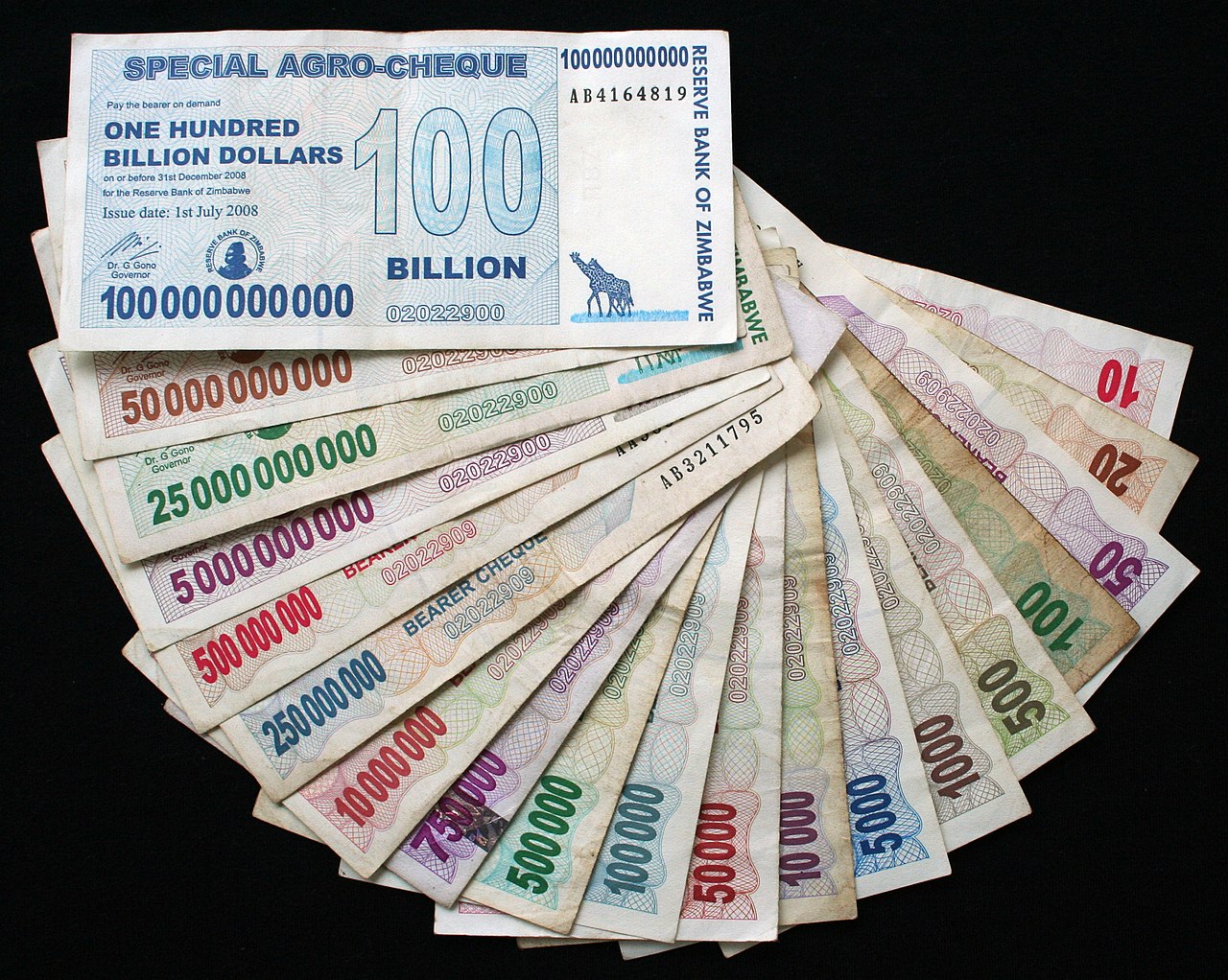
There is, however, yet another rationale behind the government's series of policy changes. It is the presumption that the more money there is, the more wealth there is. As counter-intuitive as this may sound, that is just not true. The units of money that we have in our wallets or bank accounts do not matter. If such a thing actually mattered, Zimbabweans would be the richest people in the world!

Image Source

What people really want is not more money, but more bang for their buck. In other words, they want their money to be able to buy more things. Simply increasing the amount of money, which is all that the Korean government will be able to achieve with its policies (assuming that it is successful), will simply dilute the effectiveness of the money that people do own. It will not improve the people's standard of living.

The only thing that can make the money more valuable is for there to be a fall in prices aka deflation, which is the very thing that every government wishes to avoid. After all, although deflation is what people need, it is not what they want (whether or not deflation is a good thing is an entirely different topic that shall be dealt with on another day).

To be specific, people want the prices of all goods that they buy to fall. However, at the same time, they want the price of the goods that they sell to rise. Therefore, though nobody will actually claim to want it, what their actions often belie is that everyone actually wants inflation. And politicians are only too happy to give people what they want, rather than what they need.

It is possible that the Park administration's war on savings might lead to some short-term economic gains. After all, almost anything can be proven to be correct by resorting to clever statistics. But in the long run, I just don't see how it is anything but doomed to fail.


Image Source

Wednesday, January 29, 2014

Why Is Going To College So Expensive?

Author's Note: This blog post was originally published in my previous (and less successful, and now defunct) blog in 2010 while I was still living in the United States.  Though the data, where applicable, might be a little dated and the references are US-based, the main points are still relevant today not just in the United States, but in Korea, too.


A college education seems to be one of those things that most everyone wants. Parents want it for their kids, employers want to hire those who have had it, a lot of college students think that it ought to be a right, and politicians extol its virtues.

Getting a college education is indeed a good thing. In my own experience, I can tell you that it has helped me to understand complex ideas and philosophies and especially because I studied the social sciences, going to college has helped me to reaffirm some of my own beliefs, changed some of my opinions and has also helped me to understand ideas that I do not agree with. My college life, with everything else that came along with it, was a wonderful journey and it’s a memory that I will forever cherish, even if I do not remember some of those nights.

This might have had something to do with it.
Image Source

Now there are several government aid programs that allow students to pursue higher education.

As for the GI Bill, it allows enlisted men and women in the armed forces to pursue an undergraduate or graduate degree at a college or university, a cooperative training program, or an accredited independent study program leading to a degree. It is the least that the men and women of uniform who have fought for their country deserve. On the other hand, the Free Application for Federal Student Aid (FAFSA) ensures that all eligible individuals can benefit from federally funded financial assistance for education beyond high school. The stated intentions of those two services are difficult, if not impossible, to argue against.

Now that I have gotten all the niceties out of the way, it’s time to rip them a new one.

The GI Bill was established in 1944 and it was the first of the federal government’s many forays into higher education. It wasn’t until 1958 that the National Defense Education Act, which was the precursor to the Federal Perkins Loan program, the very first federal student aid program for low-income students, was passed by Congress. Before 1944, politicians in the federal government did nothing to subsidize or regulate education.

Conventional wisdom dictates that the GI Bill and FAFSA (and all of its successors) allowed countless students to afford a college education; and had those services not been enacted by Congress, the United States would be lagging far behind other industrialized nations and could not have achieved the rate of economic growth that it has experienced since the end of the Second World War. What we have to ask ourselves is whether or not that conventional wisdom is actually correct.

The philosophical argument that is given in support of getting a college education is education itself. Education is indeed a journey that begins at birth and ends with death and the more educated people are, the better off everyone’s lives is.

But what is the practical argument that is given in support of getting a college education? I can think of only one – to be eligible for a better paying job. For that reason, many people who support the subsidization of education claim that the GI Bill and FAFSA have allowed for many people to escape from the drudgery of manual labor to become doctors, engineers, accountants, lawyers, etc.

Image Source

Don’t get me wrong; I’m certainly not against higher education. However, the problem is that many people seem to make the mistake of judging the GI Bill and FAFSA to be good because of their stated intentions rather than their results.

If the only argument in support of the GI Bill or FAFSA is the philosophical one, then my argument would be merely philosophical as well – as much as I agree that having an educated populace is a desirable thing, I do not think that the government subsidizing education is the best way to approach that goal. The thing about philosophy, however, is that it is something that people are free to, and do, disagree with ad infinitum. However, once people try to make the practical argument in support of the GI Bill or FAFSA, then my argument becomes more fundamental – has it worked?

Case in point, how many new college graduates do you know who deliver pizzas or bag groceries or sell insurance over the phone or bartend or work entry-level jobs of one kind or another? In other words, how many new college graduates do you know who work jobs that really do not need 4-year degrees to accomplish? How many college graduates do you know who absolutely needed the on-the-job training that they received from their employers because the four years that they took to major in English or Music Education or Communication or Political Science did not teach them anything about escrow?  Or how many times have you personally not been able to apply for a job because one of the job requirements is work experience and that seems to be the same requirement that all other businesses require?  I know many such people and considering my readership, chances are that you are one of them.

Image Source

Considering the fact that less than 30% of college graduates get into professions that are related to their college majors, basically, by subsidizing college education as heavily as it has done for the last several decades, the federal government has turned the college degree from a mark of important personal accomplishment into just another credential that doesn’t necessarily mean anything except that the student managed to accumulate enough college credits.

It’s true that many employers now require a college degree as a job qualification. But how many of those jobs actually require particular skills or knowledge that an applicant could have acquired only in college? The vast majority of the time, the college degree requirement is generally used by an employer as a screening device to keep from having to interview applicants with only a high school diploma or less even for the most mundane jobs because of the perception that those with only high school diplomas are less reliable than those with college degrees. Then the question that arises is that if a college degree for the most part acts as merely a screening device rather than a sign of acquired knowledge that is in need, is that expensive college degree worth it?

Image Source

But what does the cost matter to the recipient of government aid to go to school? He/She is not paying for his/her education; not directly out-of-pocket anyway. It matters for two reasons.

Firstly, nothing is for free. Just because the recipient of the GI Bill is not paying for his/her education doesn’t mean that taxpayers aren’t paying for it. And is it right for taxpayers to be forced to pay for an education whose value is not worth the price tag?

Secondly, it matters because after the government began meddling in education, it has arguably cheapened education. The GI Bill was signed into law in 1944 in order to reward the millions of soldiers who were forcibly drafted into the Second World War. Originally, it was not meant to go on after all of the military personnel who participated in the Second World War who could take advantage of the program had chosen to do so. It was supposed to be a temporary thing but then came the Korean War, the Vietnam War and so on and so forth and so not only did the GI Bill remain, it also got a post-9/11 makeover.

As Dr. Milton Friedman once said, it just goes to show you that there really is nothing as permanent as a temporary government program.

Image Source

However, people do argue that government needs to subsidize education because it is so incredibly expensive. “Think of the poor,” they say. But they are not asking the important question – why is college education so expensive?

Since 1985, overall inflation in the US has been about 107.05% whereas the inflation rate for college during the same timeline has been around 466.8%.

When something makes no mathematical sense, it’s usually because government is involved. If you are a recipient of the GI Bill’s benefits or that of FAFSA loans, think of how readily the bursar at whatever university or college or accredited school you attended accepted those checks without ever asking you a lot of questions. And why wouldn’t they? Those checks are never going to bounce. After all, it is guaranteed money by the government – it’s free money, money that has either been taxed or practically freshly printed, or in some cases, yet to be printed.

When there is subsidization and guaranteed money involved, two things happen.

Firstly, subsidization inevitably always leads to overproduction. Just ask the Iowa corn farmers.

Secondly, guaranteed money inevitably always leads to higher prices. If I can charge any price I want for the product that I am selling and I am guaranteed to be paid no matter what, what reason would I have to not increase my price? The same logic applies to colleges. If the GI Bill allows you to go college for up to $100,000 or if FAFSA allows you to borrow up to $100,000 in student loans, then like magic, the cost of going to college goes up to $100,000. Never mind the fact that the value of your education might not be worth $100,000.

By subsidizing education, the government has transformed the college experience from being one of expanding the mind to becoming a mere credential to get an entry-level job for which people are mostly over-educated. It has raised the cost of going to college so much so that very few people can now go to college without the GI Bill or FAFSA thus creating a vicious never-ending cycle. And it has allowed the marketplace to be so saturated with college degree holders that despite the fact that so many young people are in serious debt, many young people can only find work in entry-level jobs that pay peanuts, which in turn compels people to support higher minimum wage rates, which in turn exacerbates things even further.  It's a vicious cycle.

Image Source

So the next time you hear someone say that education ought to be a right that the government ought to help pay partially for or fund outright, people ought to be reminded to think of one very important thing – that famous road to hell that has been paved with the purest of good intentions.

As for that future bubble burst, the Education Bubble, that is the direct result of more and more students not being able to repay their student loans that is going to pummel the economy yet again, well, that’s a nightmare scenario that I don’t even want to think of right now.

Image Source