Last night, I read an article written on NK News. Typically, NK News is a publication that I have found to be informative and respectable. However, as I read this column about the Korean Army's jeongshin kyoyuk, the Korean military's psychological education that it administers to all members of the Armed Forces on a weekly basis, for the first time, I could not help but roll my eyes. The following are my rebuttals to the points that were made in the column. 1. This writer over-estimates the effectiveness of jeongshin kyoyuk (the South Korean military's "psychological education.") In my time in the ROK Army, I learned that they are mostly PowerPoint slides that do nothing more than bore the listeners to tears.
2. That being said, it is not a waste of time. Considering the fact that about half of South Koreans in their 20s seem to think that the Korean War began when the South invaded the North, the Korean military, despite its hamfistedness, is clumsily trying to correct this horrible wrong. Jeongshin kyoyuk can be streamlined and modernized, but it is not a waste of time. 3. "Since weekly sessions still regularly reference President Syngman Rhee and Park Chung-hee, whose administrations ended more than 50 and 30 years ago, respectively, education is outdated." As someone who has served in the South Korean Army, I can say with absolute certainty that this was a load of bullshit. I only heard President Syngman Rhee mentioned once when the lecture was about the initial partition of the Korean peninsula and President Park Chung-hee was never even mentioned. 4. The military was not, is not, and will never be a warm and fuzzy organization that just wants the whole wide world to sing Kumbaya. The military's duty is to defend the country from its enemies when all other means fail. And that means it has to train to look at the North Koreans as the enemy and kill them if it is necessary.
5. The North Koreans ARE the enemy. There are a lot of names of young boys etched on the War Memorial, some more recent than others, who were killed by North Koreans. 6. The North Korean system IS inferior. South Korea might not be perfect but unlike what happened in North Korea, millions of South Koreans did not die of starvation. 7. There are many reasons that North Korean defectors face many challenges in adapting to life in South Korea. Jeongshin kyoyuk is not one of them. The military states emphatically that North Korea is the enemy, but it has nothing but sympathy for North Korean defectors who are able to make it across. 8. Reunification policies come and go as politicians come and go. The Sunshine Policy was a disaster and this so-called Reunification Bonanza was nothing more than political posturing that was full of unsubstantiated irrational exuberance. It will have an even shorter footnote than the Sunshine Policy. In the meantime, the North Koreans have thousands of artillery pieces aimed at Seoul (see here and here), various WMDs, and a huge special forces unit that has been trained to kill as many South Koreans as indiscriminately as possible. So excuse me if I roll my eyes at this nonsensical sentimentalism in NK News and continue to view the North Koreans as a mortal threat to my country.
For
those of you who have been keeping up with the news,
a Korean soldier, who has only been identified as Lim (임)
killed five other
soldiers and injured seven others before deserting his post with his
K-2
rifle
and 60 rounds of ammunition on Saturday.
It
has been reported that the military has deployed
several helicopters and special commandos to capture Sergeant Lim.
(Lim
is a conscript and his rank is byeong-jang
(병장),
which does not have an equivalent in the US Army.)
And
as
it stands right now, the soldier who was conscripted in December 2012
and was to be discharged from active duty in September, opened fire
at some of the soldiers who has been ordered to capture him. A
platoon leader, who has also been thus far unidentified, suffered
gunshot wounds during the firefight.
It
was also reported that when Lim took a personality test in April
2013, he was classified as a “Grade-A” soldier that needed
“special attention” and was unfit for duty at a general outpost
(GOP). In Korean, those kinds of soldiers are known as gwan-shim
byeong-sa
(관심병사).
When he took the test again in November 2013, he was classified as a
“Grade-B” soldier who still needed attention, but was able to
carry out the GOP mission.
When
he took the personality test again in March this year, he was
evaluated as having no special problems.
It
has been further reported
that there are about 1,800 other soldiers that have also been
classified as requiring “special attention” in the 22nd
Army Infantry Division, where Lim had been stationed.
As
of this writing, he has yet to be apprehended, though his capture,
dead or alive, is inevitable.
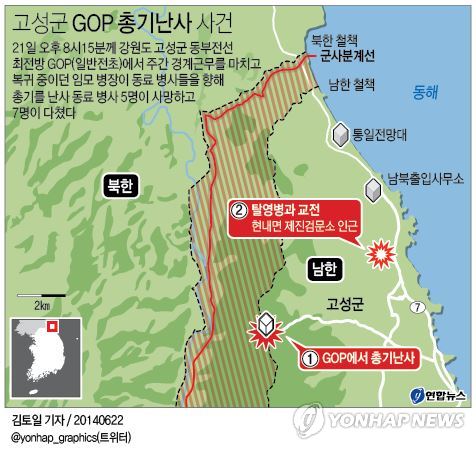
Location 1 is the GOP where the incident originally took place and Location 2 is where Sergeant Lim is currently engaged in a one-man guerrilla war. Image Source
From
this point on, I will attempt to use my experience to speculate as to
how this incident happened. Of course, I do not make any claims to
know this soldier or what he thought or what the military is
currently trying to do. I am going to explain the system that
allowed something like this to happen.
I
served in the ROK Army from June 2011 to March 2013. Though I don’t
think about those boys in the military very often as I am very busy
with my job, my personal life, and blogging, I do think about them
from time to time. And it is heartbreaking whenever these kinds of
news stories emerge.
After
all, this was not
the first time that a shooting incident like this has taken
place.
Like
anyone else who has served in the Korean military, I, too, have taken
these tests before. I took it once before I was conscripted, once
more during boot camp, and then took the test at least once every two
months during the remainder of my time in the Army.
The
test is mandatory for all conscripts and consists of around 200 to
300 questions; many of them that are similar to each other and merely
worded differently. They are multiple choice questions. The
simplest ones are “yes or no” questions and some of the harder
ones are answered by grading how strongly one feels about the
question; the answers ranging from “strongly disagree” to
“strongly agree.” The following are some of those questions that
I recall at the top of my head:
I
think that life is not worthwhile.
I
often hear voices although no one is around me.
I
feel that the world is out to get me.
If
I died, no one would notice.
I
often contemplate suicide.
I
am afraid of what kind of life I will lead after being discharged.
Of
course, there are many other questions. The ones that I picked are
the questions that the examiners look out for the most. Other
questions are mostly used to know how well an individual might adapt
to Army life, or how optimistic/contented or pessimistic/dissatisfied
a person is.
Though
I am sure that not all military bases does this the same way, in my
experience, failing this test was not an option. Let me explain.
Firstly,
if it were to be discovered that a soldier was deliberately answering
the questions to appear suicidal when the soldier is actually
mentally fit, there is the possibility that he could be thrown into
the brig. Not an altogether pleasant experience, I hear. On top of
that, the time that a soldier spends in the brig does not count
toward the number of days that he must serve in the military. For
example, if a soldier is sent to the brig for a week, his service is
extended by a week.
Secondly,
before it is determined that a soldier is faking the results, if a
soldier raises those red flags, that soldier is made to retake the
test at least one or two more times. If the soldier still raises
those red flags, then the company commander (who is usually a
captain) will have a discussion about that soldier with the rest of
his squad, his squad leader (who is usually a byeong-jang),
and his platoon commander (who is usually a non-commissioned
officer).
If
it is deduced that the soldier is not faking it, the company
commander, after consultations with the battalion commander (who is
usually a major or a lieutenant colonel) will then order that soldier
to go to a place called “the green camp.” That is where all the
maladjusted end up going where they are constantly watched to make
sure that they do not try to hurt others or themselves. They are
also never allowed to go anywhere alone; not even to the bathroom.
They are mostly made to watch videos (that are usually badly made PowerPoint slides) that have been made by the Defense Department during “mental
training lessons” (정신교육)
that are meant to instill pride and self-esteem.
Other conscripts also have to watch these videos, too, about once a week, but I was told those at the green camp are made to watch these ad nauseum.
As
I have never been ordered to go to a green camp myself, I have no
first-hand knowledge of what goes on in there.
Occasionally,
when a soldier’s case appears so extreme that the military does not
think that it has the ability to help him, the military will give him
an early discharge. However, such instances are very rare.
The
test itself is very easy to pass. Even if a soldier does hear
phantom voices and does have suicidal tendencies, the hassles that
one has to go through can be so damned tedious that most soldiers
give the answers that the test givers want to see. Most soldiers who
take the test repeatedly and still provide the same answers that
raise those red flags despite the tedium and the possibility of
wrongfully being thrown into the brig are those who are sincerely
disturbed and calling out for help. And the best they usually get is
being sent to the green camp.
In
other words, the tests are a joke. However, there is no other way to
test these soldiers.
In
the battalion that I served, there were approximately 300 conscripts
and about 40 non-commissioned officers (NCOs) and 20 commissioned
officers (COs). Each has their own functions and jobs and unless
there are outward signs that people can easily notice, it is very
hard to know which of these soldiers are ticking time bombs. As mentioned earlier, there are approximately 1,800 soldiers who require “special attention,” but not all of them are potential killers. There
is no way to know for sure that there isn’t a soldier who will
decide to do something really stupid one day.
The
ones who will know best are the squad members themselves.
However, there are a lot of disincentives that prevent those
conscripts from coming forward. Conscripts are at the bottom of the
proverbial totem pole. If they make such reports to their platoon
leader, depending on the kind of leader that they get, each and every
one of them will be questioned and interrogated to the point of
excessive tedium (which means that there will be A LOT of work that
they have to catch up on later on, which means that there won’t be
much time for them to rest even on the weekends) or they will simply
be ignored.
The
officers do not have the incentive to help much. Firstly, unlike the
conscripts, these officers are in the military by choice. The
military is not just some annoying thing that they have to go
through. It is their career. And if a conscript, some runt who is
only there for twenty-one months, messes up and is later discovered,
there is a good chance that those officers might be censured, which
means that they won’t get promoted. For an officer, there is
no clearer death knell than being passed up for promotion. Therefore, they prefer not to deal with it and want to see things buried. Out of sight, out of mind. A mere 21 months later and those trouble makers will be someone else’s problem!
(While
I was in the Army, I heard conscripts frequently saying that the
officers are not out for their best interests. Some even said that
if a war breaks out, they will kill their own officers before they
start shooting at the North Koreans.)
As
a result, the conscripts usually try to deal with whatever problems
that are on hand by themselves. However, they aren’t
psychologists. And being young boys – bored and armed to the teeth – who are usually anywhere from 19
to 22, they have little patience for the gwan-shims.
This is why a lot of bullying and hazing takes place.
If
a single conscript messes up, it’s not just him that is punished.
The entire platoon, and sometimes the entire company is punished.
And the officers don’t go unpunished either. In fact, the officers
are more severely punished than the conscipts usually are, which goes
back to why the officers are not inclined to help.
So,
the conscripts try to handle things “locally.” Unfortunately,
the bullying and hazing tactics that the conscripts rely on can be
extremely counterproductive. Therefore, as useless as these tests
are, they are the least bad way to determine if a soldier is a threat
to others and/or himself.
The
fact that the vast majority of the Korean military is composed of
conscripts, young boys who have been forcefully made to serve in the
military, is likely the biggest reason why these individuals are
there in the first place.
In
an all-volunteer military, such individuals, if discovered, can be
discharged honorably or otherwise (not that that is any guarantee that psychologically problematic individuals are not weaned out). However, in the case of Korea,
where all able-bodied Korean men are forced to serve by decree, it becomes nearly impossible to discharge them.
When
there are so many soldiers who will do anything to get out of having
to serve in the military (as can be seen here, here, and here), when there are so many who will fake being
sick, mentally or physically, the military bureaucracy does not give
a lot of opportunities for those who genuinely need help from
receiving it.
I
stand firmly opposed to military conscription for moral reasons. However, as
long as North Korea remains an existential threat to South Korea, it
will be nearly impossible to do away with conscription.
Until
this view changes, I think that these shootings will not be the last
of its kind.
Milton Friedman's Influence on Ending the Draft in the United States
My
very first post on this blog was about how Korea and Japan can both
improve their bilateral relations with one another. For those who
don’t wish to read the whole thing, it came down to one essential
idea – “Don’t
feed the trolls.” It was my first post and it was a somewhat
lighthearted attempt at writing about a complex issue between two
countries whose historical relationship with one one another has had
more downs than ups.
For
its part, Korea has done little to help matters either. Until
recently,
President Park has refused to meet with Prime Minister Abe until he
has expressed “sincerity” in regards to the issue of comfort
women despite the fact that both leaders had been elected to their
respected offices for a year. She has since reaffirmed
that she would not meet Prime Minister Abe again.
Roboseyo
has written a
thoughtful piece about Korea’s desire for Japan’s “sincerity”
on the issue (though it is most likely not a popular one among
Koreans).
Secondly,
Koreans have been insisting that the Sea of Japan be renamed the East
Sea; and have begun to include
American state legislatures over this matter.
Furthermore, the construction of a statue of Ahn
Jung-geun
in China, of all places, cannot be seen as anything else besides
Korea’s willingness to do as much as it can to sabotage relations
with Japan. Whereas Japan may be being blithe about its history and
the feelings of its neighboring countries, Korea, for its part, seems
to be showing all of the classic symptoms of PCSD (Post-Colonial
Stress Disorder).
In
a supreme example of unreasonable emotionalism, public outrage forced
Korean peacekeepers in South Sudan to return
10,000 rounds of ammunition to Japanese Defense Forces after the
commanding Korean officer asked the Japanese commander for ammunition
when the Korean peacekeepers there faced an imminent threat from
local militias. Apparently Koreans prefer to see their own soldiers
placed in harm’s way than to show even a bit of cooperation with
Japan.
Though
it is more than likely that President Obama has various agendas that
he would like to hit upon in his
Asia tour, there is very little doubt that one of the things that
he will discuss behind closed doors is his desire to see both Korea
and Japan move on from the past in order to concentrate on the now
and the future. As much as the United States has tried its best to
remain above the bickering between the two countries, it must surely
be an annoyance to have two of its closest Asian allies failing to be
cordial with one another.
The
question, of course, then becomes how effective President Obama will
be. My advice: Don’t hold your breath.
Its
diplomatic tools when negotiating with Japan, on the other hand, is a
different matter entirely. Although Japan has had some heated
clashes with China over the
Senkaku Islands, unlike Korea with its erratic northern neighbor,
Japan is not under the constant threat of existential annihilation.
Furthermore, it was just announced that President Obama has stated
that the defense of the
Senkaku Islands is covered by the U.S.-Japan Treaty of Mutual
Cooperation and Security, which means that the United States is
obligated to come to Japan’s defense should an armed conflict ever
arise between Japan and China over those islets.
Seeing
how Japan is an ally and a trading partner (whose interests, most
importantly, do not clash with those of the United States’) as well
as that it is also the
second largest holder of US debt, the United States does not have
nearly as much influence over Japan as it does over Korea as
evidenced by a
Japanese cabinet minister and about 150 lawmakers visiting
Yasukuni Shrine a day before President Obama arrived in Japan.
And,
of course, all three countries are painfully aware of these facts.
As
a result, any attempt at mediating between Korea and Japan will
likely backfire for the United States. Korea will resent being
treated like the lesser partner in the trilateral relationship, which
could push Korea toward China’s sphere of influence as was
evidenced by Foreign Minister Yun Byung-se’s statement about how
Korea
should consider forging a pact with China on sharing military
intelligence, which is a shocking statement considering that
Korea scrapped
a similar pact with Japan, a country which shares a mutual alliance
with the United States, before it could even be signed after a public
outcry in 2012.
Though
there isn’t a single Korean (who isn’t clinically insane) who
believes that Japan would ever pose a military threat to Korea as it
did in the nineteenth and early twentieth centuries, hatred toward
Japan is so intense that some Koreans are seriously considering
forming closer military partnerships with the People’s Republic of
China, a country that is known for being, among other things, North
Korea’s only ally!
(That
being said, China
is also Korea’s largest trading partner and Korea is rightly
wary of being entangled in a possible new Cold War with the United
States and Japan on one hand, and China on the other.)
Though
the United States would not have to worry about losing Japan as a key
military ally, it does need Japan to fully commit to the
Trans-Pacific
Partnership in order for it to be viable, which could become the
world’s biggest free trade agreement. However, the United States
needs the TPP more than Japan does. Japan has already signed many
bilateral trade agreements with the countries that are interested in
joining this FTA; as has the United States. However, the United
States needs the TPP more precisely because it is one of the central
pillars that is needed for President Obama’s “Asia Pivot” to
work. Japan can make things much harder for the United States (as it
has already done)
if the United States overly pressures Japanese leaders to “lose
face” by having to apologize to both Korea and China over its
wartime atrocities yet again.
Korea
does have legitimate grievances with Japan. However, there is
another reason why Korea has become more abrasive with Japan in
recent years than it has in the past. Rightly or wrongly, Koreans
believe that their time has come.
Of
course, Japan is now the third largest economy in the world and Korea
ranks fifteenth. Korea has a long way to go before it can even hope
to be Japan’s equal when it comes to raw economic power. However,
and despite the irony that Koreans appear to be the unhappiest
lot in the OECD (The Organisation for Economic Co-operation and
Development), it would appear that Koreans are more optimistic about
their future in relation to Japan.
With
the ascendancy of the nationalists in Japan following decades of
deflationary economics and a voting public that is more willing for
Japan to be more assertive in its international affairs on one hand,
and the economic rise of a former colony on the other, both sides
have begun more and more to look at each others’ relationship as a
zero-sum game.
(How
and why the nationalists became more popular in Japan requires
another and much more thoughtful analysis than I am qualified to
write about.)
I
have entertained the possibility of there needing to be a third party
that poses a mutual threat to both Korea and Japan for both countries
to bury the hatchet. However, such a scenario is overly simplistic
as it conveniently ignores the inner political and economic dynamics
of each country.
For
the foreseeable future, at least, it would seem that the power dynamics in East Asia is not conducive for a rapprochement between
Seoul and Tokyo. For good or for ill, it would seem that the
relationship between both Korea and Japan will stay frosty.