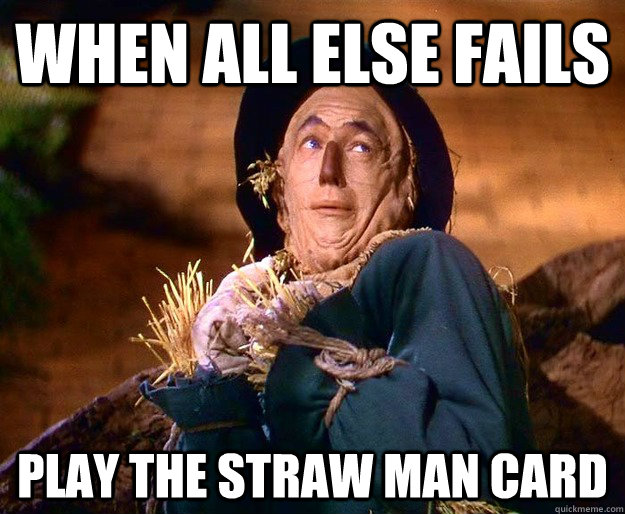
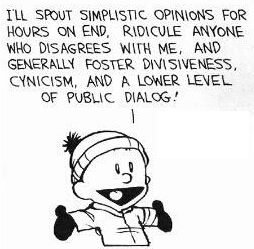
The
Straw Man Argument is a type of argument that is used to
misrepresent someone else's argument, by way of exaggeration or
misrepresentation or complete fabrication, with the intention of
making the other person's argument easier to attack. It is a
dishonest method that almost always undermines rational debate.
As
such, almost everyone hates this form of argument. However, many
people still resort to this kind of argument on a daily basis –
some deliberately, while others unknowingly. And one of the most
prominent Straw Man Arguments that have been used so excessively that
many people have come to accept the Straw Man as gospel truth is the concept of
Trickle-Down Economics.
 |
| Image Source |
It
is very easy to find arguments against trickle-down economics.
President
Obama referred to it as “thinly veiled Social
Darwinism.”
Senator
Elizabeth
Warren said that trickle-down economics “devastated
U.S. workers while propping up the wealthy.”
Pope
Francis pontificated against it, calling it a “a
crude and naïve
trust in the goodness of those wielding economic power and in the
sacralized workings of the prevailing economic system.”
(I am not sure if Pope Francis is the right person to talk about naïveté or the idiocy of faith. See here and here.)
(I am not sure if Pope Francis is the right person to talk about naïveté or the idiocy of faith. See here and here.)
Economists
have argued against it, too. For example, Paul
Krugman said that trickle-down economics is “being
nice to the wealthy and cruel to the poor.” And Robert
Reich says that it is one of the “big
lies” conservatives promise voters.
The
OECD
released a
report that said that “the benefits of growth do not
automatically trickle down across society.”
Trickle-down
economics has also been attacked and criticized by thinkers,
academics, politicians, activists, and journalists in Korea as well
(see here,
here,
here,
here, here,
and here).
The
case against trickle-down economics is clear. It is also clear that
it has some very powerful enemies.
 |
| Not a friendly face in sight... Image Source |
But who actually supports
trickle-down economics? Who is actually championing giving more to
the rich? The
answer is “No one.”
As
I already said in a
previous post:
Trickle-Down Economics does not actually exist. It is a lie. “Trickle-Down Economics” was a phrase that was devised in the United States in the 1980s when the Democratic Party needed a a catchy zinger to attack President Reagan's economic policy. The phrase was a remarkable political slogan as it painted Reagan and other advocates of tax reduction as sycophants who had all been bought and paid for by greedy billionaires at the expense of the poor and the middle class.
One
of the most prolific economists of our time, Thomas
Sowell, once challenged
anybody “to quote any economist outside of an insane asylum who had
ever advocated this “trickle-down” theory.”
To
date, no one has ever adequately answered that challenge.
Quoting
Thomas Sowell again:
Let’s do something completely unexpected: Let's stop and think. Why would anyone advocate that we “give” something to A in hopes that it would trickle down to B? Why in the world would any sane person not give it to B and cut out the middleman? But all this is moot, because there was no trickle-down theory about giving something to anybody in the first place.
 |
| Image Source |
Those
who advocate lower taxes, of which I am one, have never made their
case by supporting the idea of transferring wealth from the masses to
the rich. Rather, they emphasize the creation of additional wealth
and jobs when businesses are not hampered by burdensome regulations
and steep taxes.
However,
even that is only half of the argument. Those who champion lower
taxes do not support lowering taxes only for the rich, but also for
everyone else. Crazy as it may sound, no free market
capitalist has ever claimed that society
would become wealthier because
the
rich would spend more. Rather, they argue – correctly – that tax
cuts in general would stimulate the economy. That is because lowering
taxes is based on the idea that if the government lowers taxes, the
people – both rich and poor – will have more of their own money
and will, therefore,
tend to engage in more economic activity.
What
is undeniable is that reducing taxes does help the rich more than it helps the poor. However, that is
incidental. After all, the rich pay
far
more
than their “fair share”
of taxes. Therefore, it becomes all too easy to caricature any tax
cut as “tax cuts for the rich.”
Tax
cuts might help the rich more, but it also helps the poor. After all,
there are only four ways to spend money:
- Spend your own money on yourself.
- Spend your own money on somebody else.
- Spend somebody else’s money on yourself.
- Spend somebody else’s money on somebody else.
Therefore,
the phrases “trickle-down economics” and “tax cuts for the
rich” are nothing more than the inventions of a desperate political
mind that did not have the ability to debate the merits of an
opposing viewpoint. After all, what easier way can there be to “win”
a debate than to invent a viewpoint that no one holds, attack that
viewpoint, and then claim intellectual victory?
This is not to say that there is no need for a real debate about which policies are needed in order to promote economic growth. With all due respect to Grover Norquist, God knows that lowering marginal tax rates alone is not a panacea (see here and here). That debate is badly needed. Unfortunately, however, demagogues are far too busy trying to slay the imaginary “trickle-down” dragon.
This is not to say that there is no need for a real debate about which policies are needed in order to promote economic growth. With all due respect to Grover Norquist, God knows that lowering marginal tax rates alone is not a panacea (see here and here). That debate is badly needed. Unfortunately, however, demagogues are far too busy trying to slay the imaginary “trickle-down” dragon.
 |
| Image Source |