In
case there are those of you who have not been paying attention to
Korean news, people have been sent into fits of outrage over a
spate of child
abuse that has been reported around many of the country's daycare
centers and nurseries.
In
order to appear as though the government were doing something
constructive (something that never ceases to instill fear in me), as
it was reported
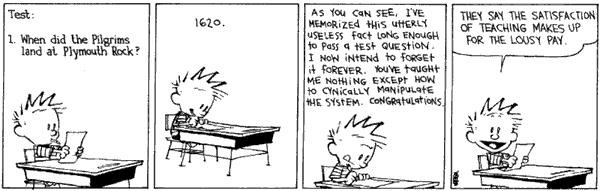
in the Korea Herald, the Korean government plans to introduce a
state-run qualification examination for daycare workers. Like as
though Korea didn't have an
excessive number of standardized exams already, the same article
reported that the Korean government plans to require a set curriculum
and a personality test for those who seek to take the national
daycare exam.
And
in the long term, the Ministry of Health and Welfare, which is
overseeing this whole mess, plans to restrict the exam applications
to those who major in child-related studies.
But
will this help to end the spate of child abuse in the country's
daycare centers? I remain unconvinced. Also, there are many other
problems that the government's proposals can lead to.
1)
Standardized Exams for Daycare Workers → One-Size-Fits-All
Education
A
standardized exam that will limit who can and who cannot work at a
daycare center will also likely standardize daycare service itself.
That is because those who are allowed to work in the daycare industry
will eventually all have the same educational background and views.
When a one-size-fits-all education model is then imposed on Korean
students from the moment they learn to walk and talk, this could
potentially further
stunt Korean students' critical thinking abilities.
2)
Growing Role of Bureaucrats and Politicians
As
the role of the government increases in how daycare centers operate,
it will enlarge the role of bureaucrats and politicians. And any time
the government gets involved in anything, there is almost always a
glut of taxpayers' money. When there is that much “free money”
available, it will further cement the
destructive symbiotic relationship that already exists between
bureaucrats and those people who run daycare centers. Skip to Number
8 on this list for more about this.
3)
Standardized Personality Tests are likely to be ineffective
Setting
up yet another standardized personality test, which this national day
care exam will require, will not be helpful in any way. Does anyone
think that this is somehow a novel idea? The Ministry of Defense has
required Korean soldiers to take such
tests for decades. In fact, while I served in the ROK Army, my battalion forced us to take these kinds of personality tests at least
once every two months, which is standard practice throughout the ROK
Armed Forces.
Yet
those tests have done little to nothing to prevent suicides,
desertion,
murders,
harassment,
or hazing
in the military. So why does anyone think that personality tests will
somehow lead to a different result for the daycare industry?
4)
Surveillance cameras obviously haven't worked
The
government also plans to force all child care facilities to install
surveillance cameras, and threatened that those without cameras will
be barred from operations in the future. However, I do not understand
what this law will accomplish. After all, those people who have
recently been arrested for abusing children were CAUGHT ON CAMERA!
5)
And who is going to pay for this?
The
government plans to raise the number of assistant teachers at
facilities to reduce the workload of daycare workers while improving
the quality of daycare services. To be specific, the government plans
to provide
6,500 assistant teachers nationwide and “all costs will be borne by
the state.” Of course, when they say “the state,” what they
really mean is “taxpayers.”
The
government plans to earmark around ₩200
billion to ₩300
billion for the move. Of course, experience says that whenever
governments say something will cost so much, it's a safe bet to
assume that it will cost much more than that amount. Which is just
perfect! Yet another reason for the government to whine about its tax
deficit
(here's an idea – how about just reducing spending?) and to
impose yet more taxes on people! Like as though that hasn't been yet
another mess!
6)
Show me the data!
The
government also plans to open an additional 450 public daycare
centers nationwide by 2017. Aside from the need to impose further
taxes on people and the other related problems that that could lead
to, have people forgotten that Korea has one
of the lowest birth rates in the world? Will opening so many
daycare centers be profitable in the long run? Will the demand for
daycare centers be consistent? If so, how long will it remain
consistent? If it will remain profitable, how long will it be before
the losses start? Will the losses be politically viable? Will it be
economically sustainable?
Where
is the cost-benefit analysis? All I see is a whole lot of nothing.
7)
Treating the Symptoms vs. Treating the Disease
Yes,
they actually said that. So if there is anyone who is reading this
who happens to teach young children or happens to be a nanny, the Korean government's message to you seems to be to go screw yourselves. How dare you
think that investing your time, energy, and soul into taking care of
the children of others could mean that you deserve to make money, you
greedy boor?
In
effect, the government has prohibited economic competition among the
45,000 or so daycare centers around the whole country. Some people
might think that this is a good thing because parents are financially
struggling and that, therefore, parents need all the help that they
can get. However, what those people also seem to be forgetting is the
maxim “you get what you pay for.”
As
daycare centers are not allowed to run as for-profit institutions,
they have no choice but to obey government diktats when it comes to
pricing, services provided, etc. Therefore, as many of these daycare
centers do not have the funds that they need to provide competitive
services, many of them cannot afford to provide high quality
amenities or teachers or service workers.
In
an attempt to make everything equal, the government has made the
entire industry, which happens to be the one of the industries that
parents trust to take care of their young children, to become equally
mediocre cesspools.
8)
How to get Rich in the Daycare Industry
But
does that mean that people who run daycare centers do not make money?
Many do struggle to survive. However, there are those who do make
money. Typically, I see nothing wrong with making money. However, in
the case of some of these daycare centers, everyone ought to have a
problem with the way they make money.
As
mentioned earlier, every single daycare center in Korea is forced to
run as a non-profit. Therefore, they are one of the most regulated
industries in the country. However, where there is regulation, there
is always room for corruption.
Case
in point, according to this article
in the Sunday Newspaper, one of the easiest ways for a daycare center
director to make a lot of money is by pilfering the children's lunch
money. Firstly, as the government promised to provide “free”
lunch meals to students, the government has to spend a total of
₩1,745
per child per meal per day.
The
following are translations from that article about what some of the
more unscrupulous daycare center directors do to make money:
- Some
daycare center directors make deals with the businesses that provide
the meals that the children eat. To explain, the directors and the
the food companies agree to create a separate bank account into which
the government will allocate the promised lunch money. For example,
if a daycare center has 100 students, the government will allocate
₩174,500 per day into that account. Assuming that the children
attend the daycare center for twenty days out of a month, the
government will allocate a total of ₩3,490,000
into the account.
The
deal that the director and the food company will make is that the
latter will provide only up to (for argument's sake) only ₩3,000,000
worth of food. The the two parties will split the remaining ₩490,000
among themselves.
- Some
daycare center directors also charge what they call “special
expenses,” which are expenses that do not include English, art, or
music lessons. These expenses can cost anywhere between ₩100,000
to ₩200,000
per child per month. It was reported that much of this money ends up
becoming part of the directors' personal slush funds.
- Some
daycare centers also employ what are known as “ghost teachers.”
After submitting fabricated documentation, instead of hiring actual
teachers and daycare workers, some directors employ part-time
workers. Some of them even employ their own family members. That is
because the government provides subsidies for each teacher that a
daycare center employs.
- Some
daycare centers also enroll what are known as “ghost children.”
Currently, the government subsidizes daycare centers that have
enrolled children. The government provides up to ₩394,000
per child who is less than a year old, ₩347,000
per child who is a year old, ₩286,000
per child who is two years old, and ₩220,000
per child who is between three to five years old.
Therefore,
even though some daycare centers may be filled up and can no longer
accept any more children, some daycare center directors still
register even more children as having enrolled in their school. That way,
the daycare center director will pocket that subsidy money, which
he/she might split with the “ghost child's” parents.
Conclusion
As
I said earlier, where there is regulation, there is always room for
corruption. Also, where there is regulation, there is always the
possibility of mediocrity. In the case of the government's regulation
of the country's daycare centers, there seems to be more than a lot
of each to go around.
If
the government truly wishes to improve the state of the country's
daycare centers, the best thing that it can do is to lift all of its
ridiculous regulations and allow them to compete like businesses
ought to compete.
This
state-run qualification examination for daycare workers will do
nothing to solve the pre-existing problems of the industry, and will
likely only make things even worse than they already are.