We cannot discount the facts. There were many things that favored her victory in 2012. The two biggest factors that favored her were that South Korea is a conservative country and also an aging one. The latter is easy to explain. Older voters tend to prefer conservative leaders. The former can be gleaned from the fact that since 1987, four out of the six presidents were conservatives.
However, those factors alone may not have been enough to have guaranteed Park’s victory. In fact, Park, who for all intents and purposes led a less than remarkable life during her years in “exile” since her father’s assassination, may never have even been able to return to politics in 1998 had she not ridden a wave of nostalgia from older voters. Her repeated invocations of “the second Miracle of the Han River” and “the new Saemaul Movement” during the campaign were deliberate attempts to stoke this sense of nostalgia for a time when rapid economic growth and dizzying changes were the norm - never mind the dictatorship!
As for the claims that she would be a dictator (laughable as they are now seeing how she turned out to be grossly incompetent rather than anything so respectable as a dictator) she was able to brush it off with two simple words - economic democratization. Her presidency was supposed to be the start of a new type of conservatism - one that continued to focus on economic growth as set forth by President Lee Myung-bak while at the same time hijacking the progressives’ most important rallying call of social and economic justice. Compassionate conservatism, if you will. Whether or not her campaign promises were at all realistic is another matter entirely.
In short, populism and nostalgia for a whitewashed past are what helped to propel Park Geun-hye into the Blue House.
 |
| “Dictatorship? What dictatorship? Accentuate the positive, eliminate the negative!” Image Source |
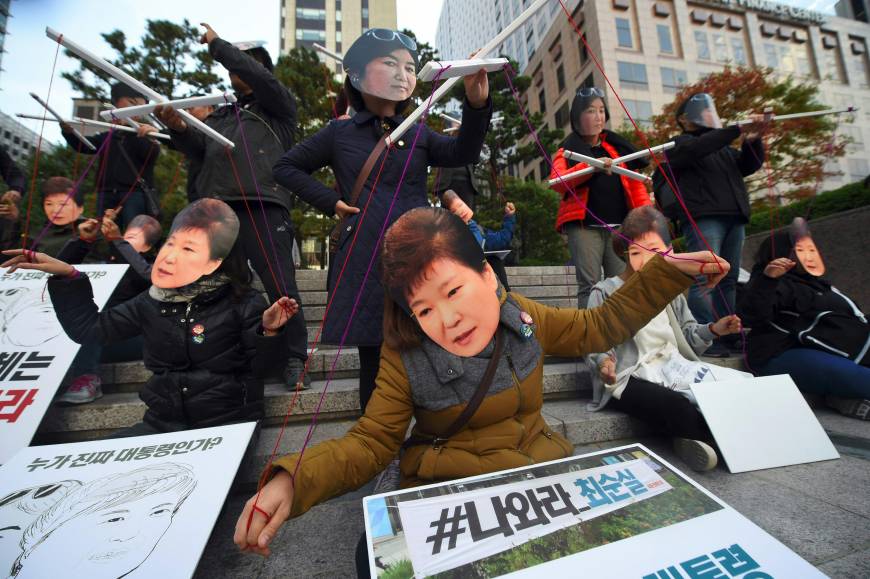
With Park’s recent statements about her willingness to resign if the National Assembly “minimizes the confusion and vacuum in state affairs and ensure a stable transfer of power,” it seems all but certain that one way or another, she will not be able to complete her single five-year term as originally scheduled. Due to the unprecedented levels of disapproval that she is currently facing from the general public, despite the fact that South Korea is a conservative and aging society, it seems that there is a very good chance that the progressives can retake the Blue House in the next presidential election.
However, the progressives cannot take anything for granted. Should Ban Ki-moon return from the United Nations next year and run for president (possibly after establishing a new party seeing how tainted the Saenuri brand is), they may fail to capture the Blue House yet again. For that very reason, just like Park Geun-hye won the election four years ago by riding on a dual wave of populism and nostalgia, the progressives are going to try to do the same but with their own twist.
But just as nostalgia that propelled Park Geun-hye into the Blue House was based on whitewashed history, the nostalgia that the progressives will ride will be based on whitewashed history, too, as it will carefully steer away from remembering the incompetence of Roh Moo-hyun’s presidency. However, there is no better time to cherry-pick memories of President Roh. That is because as ineffective as Roh Moo-hyun was as president, he was an entirely different beast as a campaigner and much of the rhetoric that he employed back then would be more than welcomed by many voters today.
For instance, not long after getting elected president, Roh Moo-hyun said:
“My fellow citizens, it is said that if everyone shares the same dream, that dream becomes a reality. A society that is run on common sense and where everyone plays by the same rules. A society where each person’s station in life will be determined by the sweat of his own brow. That is the new Republic of Korea that we all dream of. Let us work together to make that dream a reality.”
Whereas Roh gave the people a sense of hope for a society where everyone plays by the same rules, Chung Yoo-ra, Choi Soon-sil’s daughter, became modern-day Korea’s Marie Antoinette when she said something quite different. She said to her peers:
“If you are dissatisfied with your station in life, try blaming your parents instead of demanding that those with rich parents give you whatever you want. Having money is a skill, too. If you don’t like where you are in life, change it. But seeing how you’re so busy trying to tear down others, how do you expect to succeed in anything you do?”
Never mind Ms. Chung was able to live a life of luxury thanks to her mother’s money. There is nothing wrong with inheriting anything. However, the fact remains that the money that allowed her to live the way she pleased was not earned honestly, but was looted by her mother who used her political connections to become a racketeer of near-legendary proportions. In an age of unbridled and unapologetic cronyism and nepotism, nothing sounds so sweet as Roh Moo-hyun’s call for justice and equality.
 |
| The man who could do no wrong... Image Source |
A skilled orator who never shied away from addressing the public directly, Roh was the very opposite of an aloof and authoritarian leader - what Park Geun-hye is often (and justifiably) accused of being. So much so that during the height of his unpopularity, he proposed to hold a national referendum - a vote of no confidence - on himself to see just how much the public trusted him! What political leader holds votes of no confidence against himself?
Not to mention that he was an outright populist who imposed a “tax bomb” on homeowners. Although his tax policies, which were later declared to have been unconstitutional, did no favors whatsoever to help to grow the economy, in today’s political climate where many Koreans speak of noblesse oblige like as though it were some kind of religious dogma, any contemporary politician who promises to go after “the rich” will likely be cheered as a hero.
At a time when many are openly calling Saenuri lawmakers accomplices in the Park Geun-hye/Choi Soon-sil scandal and are demanding they resign en masse along with President Park, Roh Moo-hyun’s rhetoric would once again be welcomed with open arms. During his time in office, he refused to compromise with the Saenuri Party (or the Grand National Party as it was called back then). He was also a gifted orator who never hesitated to abandon protocol to speak directly to the people and a firebrand who promised to work toward building a more just society.
However, it has to be remembered that he was an ineffective leader and many have called his presidency a failure.
At a time when the public’s anti-American sentiments were threatening to tear up the US-ROK alliance, instead of trying to calm things down, Roh once famously asked a rhetorical question - “What’s wrong with being anti-American?”
Furthermore, he went on to say that the United States, South Korea’s most important ally, was the biggest threat to peace in Northeast Asia.
When he wasn’t abusing this most vital of alliances like an unwanted child, he was making a fool of himself by proposing to the Japanese government that the Sea of Japan be renamed the Sea of Peace. Or he was telling Kim Jong Il that he would be willing to redraw South Korea’s western maritime border aka the Northern Limit Line according to North Korea’s wishes in order to “draw a peace and economics map to replace the security and military one,” which would have been capitulation in all but name.
Finally, the greatest flaw of his presidency was the fact that this supposedly moral and upright man eventually felt compelled to kill himself when his family was investigated by state prosecutors on corruption charges.
 |
| ...turned out to have done a lot of wrong. Image Source |
However, none of these facts are important. At least not for those who seek to exploit his memory for their own political purposes. Yes, Roh Moo-hyun’s presidency was a failure in so many ways, but it is easy to paper over his flaws. For one thing, the amount of money that Roh was investigated for, about US$5 million, is a paltry sum of money compared to the amounts of money that were pilfered by other former presidents/shadow president. Yes, he deliberately jeopardized the alliance with the United States at every opportunity he got but he was the one who initiated talks with Washington to create the US-Korea Free Trade Agreement, which turned out to be America’s second largest FTA deal. And the Hankyoreh has already been pathetically defending Roh’s attempt to surrender the NLL for years.
But it might not even be necessary to defend Roh’s record seeing how extremely unpopular Park Geun-hye has become. All that the progressives may need to do is to echo his words and rhetorical flair, his style, sing that old song about a just society, and most importantly, repeat ad nauseum that they are not Park Geun-hye. Never mind that Roh was unable to deliver on many of his promises and much of it was due to his own incompetence.
The next South Korean president is going to be a progressive. Even if Ban Ki-moon runs for president and wins, he is not exactly known for being a conservative. And especially considering how the conservatives were willing to take a left turn on economic policy back in 2012 (not to mention Trump’s populism that helped him to win the US presidential election), it’s clear that conservative economic principles as they were set forth by Reagan and Thatcher are no longer sacrosanct for conservative politicians. So there is more than a plausible chance that there will be a marked increase in populist rhetoric and campaign pledges regardless of the political party that the candidates will hail from.
As for nostalgia, the conservatives do not have any left to exploit. Park Geun-hye squandered what little good will that people had for her father, Lee Myung-bak remains a polarizing figure, Kim Young-sam left office with higher approval ratings than Park Geun-hye currently enjoys but that’s not saying much, and the rest were thieving autocrats. But the progressives can and they will.
Moon Jae-in is already doing whatever he can to get ahead of the pack. So is Ahn Cheol-soo. Others will soon follow suit. As the race gets more heated, one should not be surprised to see the ghost of Roh Moo-hyun hovering around wherever they go.