Park Geun-hye’s impeachment has brought nine years of conservative governance in Korea to a screeching halt. Now that there isn’t a single conservative candidate who has not been tainted by the Park Geun-hye/Choi Soon-sil scandal to one degree or another, it is all but guaranteed that the next president is going to come from the progressive Minjoo Party. And as I mentioned over the weekend, Moon Jae-in is now the man to beat.
Seeing how he was President Roh Moo-hyun’s former chief of staff, Moon is taking great pains to tell voters (and foreign observers) that he’s not anti-American. However, no matter how much Moon may wish to distance himself from his past, the Korean Left will have a much harder time of doing that. It wasn’t that long ago when Korean protesters were stomping on or burning American flags. Businesses blatantly refused to serve American customers and a good number of American citizens who lived in Korea at the time were assaulted and harassed on a daily basis. Many of them were forced to pretend to be Canadians to avoid harassment.
While the conservatives have been in charge, overt anti-Americanism practically disappeared. That is not to say that the conservatives were the only reason that anti-Americanism retreated. To be sure, there were other reasons as well. Today’s young Koreans’ nationalism is based on their identity as South Koreans, which is different from ten to fifteen years ago when minjok was the popular refrain. The KORUS FTA, which has also helped to deepen trade ties between the two countries, also helped to force back anti-Americanism. Ironically, the KORUS FTA was first initiated by President Roh Moo-hyun who once rhetorically asked “What’s wrong with being anti-American?”
However, it would be a mistake to think that Korea’s progressives have completely given up on viewing the United States as the enemy. When the first pieces of THAAD’s system arrived at Osan Air Base, the Minjoo Party’s chairperson, Choo Mi-ae falsely claimed that it was done in secret; that it was agreed upon by illegitimate political leaders who hoodwinked the Korean people. She went so far as to say that bringing in those components was a violation of Korea’s sovereignty.
On the other hand, the only thing that Choo Mi-ae has said about China’s bullying and (unofficial) sanctions against South Korea’s economy vis-a-vis the latter’s THAAD deployment was that it was “excessive.”
Choo Mi-ae, who doesn't even know how binoculars work, thinks her opinion on THAAD matters. Image Source
Especially with the boorish Donald Trump in the White House, the stage is set for anti-Americanism to return with a vengeance. Considering what we already know about Trump and the Korean Left, things could get ugly. When the Korean Left takes over the reins of power, they will have a responsibility to behave like adults. However, they are not in power yet. The ones who are in power and who are in the position to do anything to try to mitigate this are American Republicans. God help us all!
Deploying THAAD anti-missile batteries in South Korea has been contentious to say the least. There is a significant portion of the population that believes that it does more harm than good. After all, THAAD will not protect the 20 million or so people who live in Seoul (Seoul will be targeted by short-range rockets and artillery barrages and THAAD was never designed to counter those threats anyway). THAAD’s defensive capabilities are designed to better protect American military personnel and assets as well as the American mainland from long-range North Korean missiles.
The alliance between the United States and Korea is a mutual one. That means that Korea has to come to America’s aid as much as America has to come to Korea’s aid in the event of a military conflict that affects either nation. Especially at a time when “America First” rhetoric (never mind its historical roots) has permeated the American political landscape, it would be ill-advised for the Korean government to confirm what many American voters and government officials already falsely believe - that allies take and take and take but never give anything back.
However, THAAD has put Korea in China’s crosshairs. China’s unofficial sanctions have hurt Korean businesses. From Kpop stars to duty free shops to Lotte to practically any business that relies on the Chinese market, Korean businesses are hurting. A more thorough study would have to be conducted to deduce just how much China’s sanctions are costing Korea’s economy. But in politics, perception is oftentimes more than enough.
When the average Korean citizen feels he is worse off because of THAAD, which really doesn’t do much to protect Koreans, it would only be natural for more and more Koreans to question its benefits over time. The United States can nip this in the bud. President Trump ought to make a statement that the United States stands firmly with South Korea; that the United States would not sit idly by while China pushes around one of its most important allies. He should say publicly that his administration will look into ways to deepen trade ties between Seoul and Washington in order to alleviate the economic burden that THAAD has thrown onto Koreans’ collective shoulders.
However, the only American official of any real importance to have said anything about China’s bullying of South Korea over THAAD is Senator John McCain. No one in the Trump administration is saying a word to support Korea! This is irresponsible and yet another indication of the Trump administration’s sheer incompetence. In less than sixty days, South Korea is going to have a new government that will be populated by people who have a long history of anti-Americanism. All they need is the right excuse to resurrect it. They’ll be able to say that they stood up to American bullies and helped to improve economic relations with China and they will likely get rewarded by voters.
President Donald Trump and Secretary of State Rex Tillerson ought to be doing everything they can to try their best to avoid that more-than-plausible eventuality. And yet there is nothing but silence from Washington. Never mind that Trump can’t seem to keep quiet about anything else!
If the worst does come to pass and if future American historians ask who lost South Korea, they can look back at this moment now and know without a doubt that President Trump’s silence was where it all started!
I don’t know which honorific to use to refer to Park Geun-hye anymore. All former presidents, no matter how disgraced they later became, are still referred to as Former President So-and-So. But none of them was successfully impeached. So do we call her Former Saenuri Chairperson Park Geun-hye or do we just call her Park Geun-hye-씨? MBN seems to think that “Former President Park Geun-hye” is still the appropriate honorific, but I am not convinced.
And it turns out that Ms. Park (that sounds about right) has still not left the Blue House. Seeing how she has been stripped from her constitutionally-guaranteed immunity from prosecution, it may yet be possible to see her eventually led out of the Blue House with handcuffs around her wrists.
Ms. Park’s silence since the verdict is a slap in the face to every conservative in the country. Three people - people who protested against her impeachment - have died while protesting the Constitutional Court’s decision. Her supporters also attacked journalists for simply doing their job. She should have issued a statement renouncing violence. She should have urged calm. And she should have publicly announced that she, and everyone else, would accept the Court’s ruling - just like she said President Roh Moo-hyun should accept the Court’s ruling when he was impeached - regardless of the decision. Her silence is a betrayal of her supporters and the rule of law. It is indecent and a perfect example of how a leader ought not to behave. It was her final insult to anyone who had ever voted for her.
That being said, unlike many people, I don’t take any joy in her impeachment. All I see is tragedy. Her political career lasted for 18 years and the Queen of Elections had every reason in the world to become a great leader - to exonerate her father’s legacy, to squash once and for all the accusations that she and her cronies are corrupt power-lusters, to prove that conservative values could help to lead Korea into the 21st century. She failed completely. Her impeachment was a victory for justice and Korea’s young democracy. But I take no joy in seeing her downfall.
As expected, Moon Jae-in is the man to beat in the upcoming presidential election. Anyone who has ever read anything that I had to say about him would know that I utterly despise the man. Donald Trump is already in the White House (another man whom I have nothing but contempt for) and Moon Jae-in will most likely be the next occupant of the Blue House. A toxic shit storm is brewing; and Kim Jong Un, the Fat Boy King of the North, laughs.
Seeing how he started out by opposing THAAD’s deployment to becoming ambivalent, to seemingly oppose it again, China is likely laughing, too.
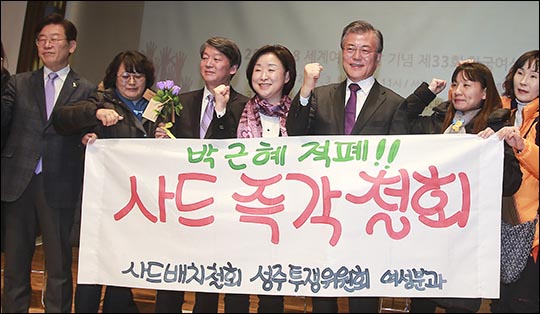
This picture was taken on March 8th 2017. It says "Withdraw THAAD immediately." Image Source
If Moon becomes president and pledges to withdraw the THAAD anti-missile batteries, China will always remember that all it needs to do to convince the South Korean government to do anything is exert just a little economic pressure and it will cave every single time. South Korea’s sovereignty will effectively belong to China. But Moon Jae-in and Choo Mi-ae will be able to say that they stood up to the United States. Never mind that amid Chinese bullying and North Korean aggression and Japanese rising militarism, South Korea’s only friend is the United States!
In short, South Korea’s dark days are not behind it. Things are going to get much darker yet.
Considering President Park Geun-hye’s dismal approval ratings, her electoral win for the presidency back in 2012 seems like more than a distant memory. However, in order to understand how her successor is going to become the next president, it is important to understand how she won in the first place.
We cannot discount the facts. There were many things that favored her victory in 2012. The two biggest factors that favored her were that South Korea is a conservative country and also an aging one. The latter is easy to explain. Older voters tend to prefer conservative leaders. The former can be gleaned from the fact that since 1987, four out of the six presidents were conservatives.
However, those factors alone may not have been enough to have guaranteed Park’s victory. In fact, Park, who for all intents and purposes led a less than remarkable life during her years in “exile” since her father’s assassination, may never have even been able to return to politics in 1998 had she not ridden a wave of nostalgia from older voters. Her repeated invocations of “the second Miracle of the Han River” and “the new Saemaul Movement” during the campaign were deliberate attempts to stoke this sense of nostalgia for a time when rapid economic growth and dizzying changes were the norm - never mind the dictatorship!
As for the claims that she would be a dictator (laughable as they are now seeing how she turned out to be grossly incompetent rather than anything so respectable as a dictator) she was able to brush it off with two simple words - economic democratization. Her presidency was supposed to be the start of a new type of conservatism - one that continued to focus on economic growth as set forth by President Lee Myung-bak while at the same time hijacking the progressives’ most important rallying call of social and economic justice. Compassionate conservatism, if you will. Whether or not her campaign promises were at all realistic is another matter entirely.
In short, populism and nostalgia for a whitewashed past are what helped to propel Park Geun-hye into the Blue House.
“Dictatorship? What dictatorship? Accentuate the positive, eliminate the negative!” Image Source
With Park’s recent statements about her willingness to resign if the National Assembly “minimizes the confusion and vacuum in state affairs and ensure a stable transfer of power,” it seems all but certain that one way or another, she will not be able to complete her single five-year term as originally scheduled. Due to the unprecedented levels of disapproval that she is currently facing from the general public, despite the fact that South Korea is a conservative and aging society, it seems that there is a very good chance that the progressives can retake the Blue House in the next presidential election.
However, the progressives cannot take anything for granted. Should Ban Ki-moon return from the United Nations next year and run for president (possibly after establishing a new party seeing how tainted the Saenuri brand is), they may fail to capture the Blue House yet again. For that very reason, just like Park Geun-hye won the election four years ago by riding on a dual wave of populism and nostalgia, the progressives are going to try to do the same but with their own twist.
But just as nostalgia that propelled Park Geun-hye into the Blue House was based on whitewashed history, the nostalgia that the progressives will ride will be based on whitewashed history, too, as it will carefully steer away from remembering the incompetence of Roh Moo-hyun’s presidency. However, there is no better time to cherry-pick memories of President Roh. That is because as ineffective as Roh Moo-hyun was as president, he was an entirely different beast as a campaigner and much of the rhetoric that he employed back then would be more than welcomed by many voters today.
For instance, not long after getting elected president, Roh Moo-hyun said:
“My fellow citizens, it is said that if everyone shares the same dream, that dream becomes a reality. A society that is run on common sense and where everyone plays by the same rules. A society where each person’s station in life will be determined by the sweat of his own brow. That is the new Republic of Korea that we all dream of. Let us work together to make that dream a reality.”
Whereas Roh gave the people a sense of hope for a society where everyone plays by the same rules, Chung Yoo-ra, Choi Soon-sil’s daughter, became modern-day Korea’s Marie Antoinette when she said something quite different. She said to her peers:
“If you are dissatisfied with your station in life, try blaming your parents instead of demanding that those with rich parents give you whatever you want. Having money is a skill, too. If you don’t like where you are in life, change it. But seeing how you’re so busy trying to tear down others, how do you expect to succeed in anything you do?”
Never mind Ms. Chung was able to live a life of luxury thanks to her mother’s money. There is nothing wrong with inheriting anything. However, the fact remains that the money that allowed her to live the way she pleased was not earned honestly, but was looted by her mother who used her political connections to become a racketeer of near-legendary proportions. In an age of unbridled and unapologetic cronyism and nepotism, nothing sounds so sweet as Roh Moo-hyun’s call for justice and equality.
A skilled orator who never shied away from addressing the public directly, Roh was the very opposite of an aloof and authoritarian leader - what Park Geun-hye is often (and justifiably) accused of being. So much so that during the height of his unpopularity, he proposed to hold a national referendum - a vote of no confidence - on himself to see just how much the public trusted him! What political leader holds votes of no confidence against himself?
Not to mention that he was an outright populist who imposed a “tax bomb” on homeowners. Although his tax policies, which were later declared to have been unconstitutional, did no favors whatsoever to help to grow the economy, in today’s political climate where many Koreans speak of noblesse oblige like as though it were some kind of religious dogma, any contemporary politician who promises to go after “the rich” will likely be cheered as a hero.
At a time when many are openly calling Saenuri lawmakers accomplices in the Park Geun-hye/Choi Soon-sil scandal and are demanding they resign en masse along with President Park, Roh Moo-hyun’s rhetoric would once again be welcomed with open arms. During his time in office, he refused to compromise with the Saenuri Party (or the Grand National Party as it was called back then). He was also a gifted orator who never hesitated to abandon protocol to speak directly to the people and a firebrand who promised to work toward building a more just society.
However, it has to be remembered that he was an ineffective leader and many have called his presidency a failure.
At a time when the public’s anti-American sentiments were threatening to tear up the US-ROK alliance, instead of trying to calm things down, Roh once famously asked a rhetorical question - “What’s wrong with being anti-American?” Furthermore, he went on to say that the United States, South Korea’s most important ally, was the biggest threat to peace in Northeast Asia.
When he wasn’t abusing this most vital of alliances like an unwanted child, he was making a fool of himself by proposing to the Japanese government that the Sea of Japan be renamed the Sea of Peace. Or he was telling Kim Jong Il that he would be willing to redraw South Korea’s western maritime border aka the Northern Limit Line according to North Korea’s wishes in order to “draw a peace and economics map to replace the security and military one,” which would have been capitulation in all but name.
Finally, the greatest flaw of his presidency was the fact that this supposedly moral and upright man eventually felt compelled to kill himself when his family was investigated by state prosecutors on corruption charges.
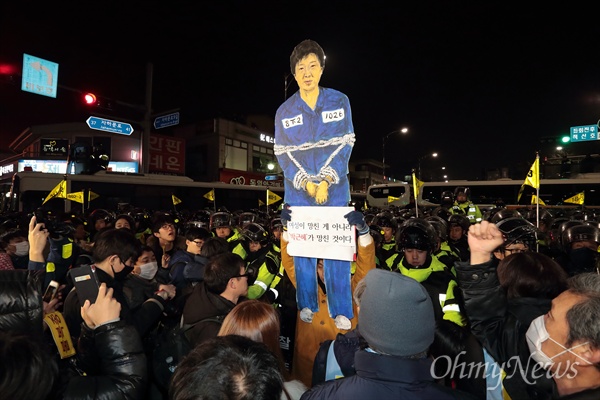
...turned out to have done a lot of wrong. Image Source
However, none of these facts are important. At least not for those who seek to exploit his memory for their own political purposes. Yes, Roh Moo-hyun’s presidency was a failure in so many ways, but it is easy to paper over his flaws. For one thing, the amount of money that Roh was investigated for, about US$5 million, is a paltry sum of money compared to the amounts of money that were pilfered by other former presidents/shadow president. Yes, he deliberately jeopardized the alliance with the United States at every opportunity he got but he was the one who initiated talks with Washington to create the US-Korea Free Trade Agreement, which turned out to be America’s second largest FTA deal. And the Hankyoreh has already been pathetically defending Roh’s attempt to surrender the NLL for years.
But it might not even be necessary to defend Roh’s record seeing how extremely unpopular Park Geun-hye has become. All that the progressives may need to do is to echo his words and rhetorical flair, his style, sing that old song about a just society, and most importantly, repeat ad nauseum that they are not Park Geun-hye. Never mind that Roh was unable to deliver on many of his promises and much of it was due to his own incompetence.
The next South Korean president is going to be a progressive. Even if Ban Ki-moon runs for president and wins, he is not exactly known for being a conservative. And especially considering how the conservatives were willing to take a left turn on economic policy back in 2012 (not to mention Trump’s populism that helped him to win the US presidential election), it’s clear that conservative economic principles as they were set forth by Reagan and Thatcher are no longer sacrosanct for conservative politicians. So there is more than a plausible chance that there will be a marked increase in populist rhetoric and campaign pledges regardless of the political party that the candidates will hail from.
As for nostalgia, the conservatives do not have any left to exploit. Park Geun-hye squandered what little good will that people had for her father, Lee Myung-bak remains a polarizing figure, Kim Young-sam left office with higher approval ratings than Park Geun-hye currently enjoys but that’s not saying much, and the rest were thieving autocrats. But the progressives can and they will.
Moon Jae-in is already doing whatever he can to get ahead of the pack. So is Ahn Cheol-soo. Others will soon follow suit. As the race gets more heated, one should not be surprised to see the ghost of Roh Moo-hyun hovering around wherever they go.
A
few days ago, John Oliver from HBO's “Last
Week Tonight with John Oliver” presented a three-and-a-half-minute long segment entitled “Ayn
Rand– How is she still a thing?”
To
those unaware, I have considered myself a student of
Objectivism
and have been studying the philosophy for many years. So, when I
watched the segment and saw that it was full of the same kinds of
ridiculous attacks against Rand that have been around for decades, I
simply rolled my eyes and went about the rest of my day. However, I
also had the sense that it was only a matter of time before the video
would soon spread all over the Internet.
There
are people who claim that “Last Week Tonight” is a comedy show and that it is meant for a laugh and not to be taken seriously. However,
the problem is that people DO take these comedy shows seriously. I
have seen a lot of articles that said that Jon
Stewart, John Oliver's previous boss, was one of the most trusted
names in news (see here
and here).
And now similar
things are being said of John Oliver as well.
Whether
that means that people trust comedians a lot, or they just distrust
other news shows a lot is a different question. However, the fact of
the matter is that comedian pundits have become one of the most
seriously-treated modern-day arbiters of “knowledge.” I find it
quite disheartening.
Seeing
how John Oliver is a well-known and beloved comedian with his own TV
show on HBO and I am but a small-time blogger, it is very unlikely
that this (admittedly) lengthy post that details where John Oliver
went wrong with his criticisms of Ayn Rand will get nearly as much
publicity as his three-minute video.
But,
well, I have time on my hands today and this is a topic that I am
passionate about. So these are the things that John Oliver got wrong
about Ayn Rand and Objectivism.
1.
“Ayn Rand became famous for her philosophy of Objectivism, which is
a nice way of saying “being a selfish asshole.””
The
people who made this video are either intentionally or
unintentionally misrepresenting Ayn Rand from the get-go. Yes, the
word “selfishness” is very much associated with Ayn Rand. But
what did she mean by “selfishness?” Did she mean it the way the
makers of this video did by comparing it with Drake's song when he
said, “It's all about me, don't give a fuck about you,” or when
that woman said “I will fucking kill you?”
No,
certainly not. To find out what she meant by “selfishness,”
check this link here.
2.
Ayn Rand's quote taken out of context – “Why is it good to want
others to be happy? You can make others happy when and if those
others mean something to you selfishly.”
This
was the part of the video that probably got a lot of people thinking
that Ayn Rand's selfishness was, indeed, about “It's all about
me, don't give a fuck about you.”
But
you have to take the interview
into context. The clip was taken from an interview that she gave to
Tom Snyder and you can find the entire 30-minute video here.
The philosophical topics being discussed prior to her talking about
the happiness of oneself and the happiness of others were about
sacrifice,
altruism,
and Immanuel
Kant.
Can you imagine modern-day talk shows talking about such heady subjects? It would be the fastest way to get canceled! Source
Now
listen to the whole segment of what she said about the topic of
happiness in that lecture, instead of the five second clip that those
comedians cherry-picked. The segment is from 21:32 to 24:22. It is
hardly a case of “It's all about me, don't give a fuck about you.”
3.
“Stories of rapey heroes complaining about how nobody appreciates
their true genius.” (Part 1)
That
snide comment about “rapey heroes” was taken from “The
Fountainhead,” when the main character, Howard Roark,
supposedly “rapes” the female heroine, Dominique Francon. Thus
began the myth that Rand was somehow pro-rape.
I
don't have a link to what Rand said about the rape scene so I will
copy/paste from the book “Letters
of Ayn Rand.”
“But
the fact is that Roark did not actually rape Dominique; she had asked
for it, and he knew that she wanted it. A man who would force
himself on a woman against her wishes would be committing a dreadful
crime. What Dominique liked about Roark was the fact that he took
the responsibility for their romance and for his own actions. Most
men nowadays, like Peter Keating, expect to seduce a woman, or rather
they let her seduce them and thus shift the responsibility to her.
That is what a truly feminine woman would despise. The lesson in the
Roark-Dominique romance is one of spiritual strength and
self-confidence, not of physical violence.
“It
was not an actual rape, but a symbolic action which Dominique all but
invited. This was the action she wanted and Howard Roark knew it.”
Now
was it unfortunate that she used the word “rape?” It certainly
was. The word has some strong meaning behind it and it has gotten
much stronger since Ayn Rand used it.
Now
there is certainly an interesting factoid about Rand that Professor
Jennifer Burns mentioned
in her book “Ayn
Rand: Goddess of the Free Market.” When “The
Fountainhead” had been just published, one of the reasons for
the book's success was the torrid love scenes, which some could
consider as an early form of BDSM-literature.
During a book signing, when a member of the audience asked Rand whether the sex scenes were based on her own sexual experiences, she
supposedly uncharacteristically playfully said something along the
lines of it merely being her fantasy.
Now,
I am a Redditor. And while browsing Reddit
over the years, I have come across on numerous occasions when people
have made confessions of their BDSM and rape fantasies. The stories
were all the same – they were confused, they knew rape to be
immoral and illegal, they felt guilty, and they didn't know what to
do. Many commenters, however, did not reproach them. In fact, many
commenters said that such fantasies were not all that bizarre and
that there is a community that engages in “rape fantasies,” all
practiced with mutual consent – that the healthy thing to do is to
talk openly about it with compassionate people who will not label
them as freaks for being different.
People
can be very understanding. Until Ayn Rand's name is mentioned. Then
she just becomes “rapey.” Seeing how so many people tend to
project
their life experiences onto out-of-context quotes or misquotes of Ayn
Rand, she really is a Rorschach
test.
Did you know that this character can also be traced back to Ayn Rand's philosophy of Objectivism? Source
4.
“Stories of rapey heroes complaining about how nobody appreciates
their true genius.” (Part 2)
Ayn
Rand's four major works of fiction were “The
Fountainhead,” “Atlas
Shrugged,” “We
the Living,” and “Anthem.”
I have read them all and not once have I ever come across any of her
heroes complaining that nobody appreciated their true genius. In
fact, not caring about the opinions of others is one of their central
characteristics.
Case
in point, this is a clip from the movie adaptation of “The Fountainhead,” which the original clip mocked, that shows Howard Roark having a
short conversation with the story's main villain, Ellsworth Toohey.
Obviously,
those sixteen-year-old children most likely do not possess the pride
that Ayn Rand talked about.
So
comparing the selfishness, the pride, and the self-esteem that Ayn
Rand advocated to that of spoiled children is simply yet another
example of intellectual laziness.
6.
“Ayn Rand has always been popular with teenagers but she's
something you're supposed to grow out of like Ska music or handjobs.”
Firstly,
this one sentence contains
several logical
fallacies and it will take more time than it has already taken to
tackle each one of them.
Secondly, I prefer not to respond to insults.
7.
“Mark Cuban's favorite book is about a misunderstood visionary who
blows things up when he doesn't get his way.”
Please, allow me to set up a hypothetical scenario for you. Let's say you
are a photographer who wishes to make it big. And let's say that a
bona fide expert said that he likes your photos; that there is real
potential for getting them published in a fancy magazine or to open
your very own gallery in Gangnam.
However, there are conditions.
In
order to get more Koreans to like and want to buy your photos, you
have to take more pictures of white people eating kimchi while giving
a thumbs up. And preferably this will all take place on Dokdo while
they are stomping on a Japanese flag. He then assures you that those
pictures will be a big hit and that you will earn a generous sum of
money for them as well as a glowing review in all the major newspapers
in the country.
Would
you take such a picture for that kind of prestige or honor or money?
Or would you refuse and continue to take photographs the way you
like?
Ayn
Rand's point was not simply about throwing tantrums if you don't get
your way. Claiming that “The Fountainhead” was a story about an architect and his profession is analogous to claiming that “Animal Farm” was about farm animals.
Assuming that the judgments and decisions that you have
made were reached via an intelligent and rational thought process, it
was about staying true to your principles;
about not giving an inch to those who are mediocre.
8.
“Cuban even named his 287-foot yacht “Fountainhead,” because
sometimes, having a 287-foot yacht just isn't enough to warn people
you're a douchebag.”
Why
is owning that big of a yacht a sign of being a douchebag? Now,
personally, I have never heard of Mark Cuban before. I don't know
him or anything he has said or done. Maybe he IS a douchebag. I
don't know if he is or not.
But
why is owning a big yacht a sign of being a douchebag? Did he steal
it? I think it would be difficult to steal a boat that big and not
be questioned by the police, no? Or does being rich automatically make
someone a douchebag, no questions asked?
9.
“However, Ayn Rand is an unlikely hero for conservatives.”
The
only thing that the video got absolutely right was that she has taken
strong positions that conservatives would never agree with, especially in regards
to abortion,
her atheism,
and her
opinions of President Ronald Reagan. Conservatives have indeed
cherry-picked bits of her ideas that they like while discarding the
rest.
The
following is what Ayn Rand said about conservatives:
That
probably explains why while she was alive, conservatives didn't side
with her at all. Many of them found her views toxic. Case in point, here is what
William
F. Buckley Jr., the founder of the National Review, had to say about Ayn Rand:
Modern-day
conservatives, who have seemingly conveniently forgotten that they used to abhor her, have attempted a type of revisionist history in their
selective embrace of Ayn Rand.
By
the way, the people who at least initially attempted to side with her
by cherry-picking some of her ideas but discarding those that they
did not like were the libertarians. For that reason, Ayn
Rand HATED libertarians. To her, libertarians were worse than
communists. To use an analogy, she probably would have likened
communists to barbarians at the gates, and libertarians to sleeper
cells within the besieged walls. She thought that by discarding some
of her key philosophical views, which she thought were paramount for
Objectivism to work, they were undermining the cause of liberty from
within.
10.“I do not think they (Native Americans) have a right to live in
any country merely because they were born here (the United States)
and acted and lived like savages.”
This
is the big one – hew view about Native Americans. This was
something that the people behind “Last Week Tonight” got partly right.
She did say it. It was a response that she gave to a question that she received during a Q&A session at the United States Military Academy at Westpoint. This is the full transcript of what she said.
In
her book, “Return
of the Primitive: The Anti-Industrial Revolution,”
she spelled out that she rejected primitivism
and tribalism,
and argued that they are symptoms of an “anti-industrial”
mentality. As far as Rand was concerned, a proper civilization was
one that respected individual
property rights, because the right to property was one of the
requirements for man's survival in this world. Furthermore, she was adamant that a rights-respecting civilization is paramount in order to free Man from men.
However,
she argued that Native Americans did not practice private property
rights; that they practiced communal “rights” to property, which
they used to eke out a subsistence-based life. Therefore, as Native
Americans' practices were primitive and did not respect individual rights, the sort of thing that people need in order to live rational,
independent lives, she argued that they were savages.
Therefore,
she argued that Western colonialists who came to the New World armed with
the knowledge of rights, ipso facto, had the right to take the land
for their own use.
So,
when she used the word “savage,” contrary to what the video insinuated, she did not mean that they were
redskinned humanoids. She was using the word as the word actually
means
– a
member of a people regarded as primitive and uncivilized.
Regardless of what she meant, however, she was wrong.
For
other views about Native Americans and private property rights, I found this page
on Reddit to be particularly helpful.
The
only thing that Ayn Rand knew about Native Americans was that when
they were still powerful enough, they killed scores of European
colonialists. However, she never mentioned how Europeans took part
in the ethnic cleansing of Native Americans. Did that mean she was
racist? No. Considering what she thought about racism
and what she thought about Native Americans, it is unlikely that she
cheered their being slaughtered, but it is also unlikely that she was
particularly sorry to see them go the way of history. Either way,
she was wrong about them being primitive savages.
Now
how did Rand, who was such an intelligent person, get this one so
dead wrong?
I
honestly don't know. She liked to claim that all of her judgments
were based on a rational thought process based on the knowledge that
was available. So... was she truly being rational all the time and
did she not let bias cloud her judgment at all? Perhaps not. I am of the
opinion that no
one is really unbiased. We can try to be as unbiased as we can (the key word here being “try”), but I think that our own limitations as human beings prevent us from
being completely unbiased.
Or
was it because history text books at that time weren't giving
accurate information about Native American history? I don't know.
I'm not an expert about how American history was taught from the
1920s to the 1970s. Perhaps someone else who does know can expound on
that topic.
If
the way that American history was taught at the time, especially about Native Americans, was, indeed, inaccurate, then I think we can chalk this one up
to her being the product of her times.
However,
if the way that the history of Native Americans being taught to the
general public in that era was not all that different from the way it
is taught today, which I find doubtful, then, at least as far as this
topic goes, Rand would have been guilty of being intellectually lazy,
too.
Conclusion
So,
she was wrong about Native Americans. Was she wrong about other
things, too? Certainly. I definitely disagree with the way she
portrayed the power-dynamics that occur between men and women. She
thought that women always had to be “under” men – that women
could not be happy if they tried to be “above” men. I disagree with that.
There
are things that Rand said that I, and probably other Objectivists,
too, disagree with.
So
why do I still like Rand so much? Well, firstly, I have concluded
that she tended to be right more often than she was wrong. Secondly,
there's a reason why her philosophy is called “Objectivism,” and
not “Randianism.”
Rand
did a lot of thinking in her day. She was right about a lot of
things, and she was wrong about some other things. As a student of
Objectivism, I think that I owe it to myself to do my own thinking
based on new information and knowledge that is presented to me; and
not to rely on everything that Ayn Rand said. For those who disagree with Rand, there is nothing wrong with disagreeing with her. However, if you are going to disagree with Rand, perhaps it might be a good idea to actually familiarize yourself with her work, rather than rely on the biased commentary of others.