Showing posts with label democracy. Show all posts

Saturday, March 11, 2017

Random Thoughts about Park Geun-hye, Her Impeachment, and What Comes Next

I don’t know which honorific to use to refer to Park Geun-hye anymore. All former presidents, no matter how disgraced they later became, are still referred to as Former President So-and-So. But none of them was successfully impeached. So do we call her Former Saenuri Chairperson Park Geun-hye or do we just call her Park Geun-hye-씨? MBN seems to think that “Former President Park Geun-hye” is still the appropriate honorific, but I am not convinced.

And it turns out that Ms. Park (that sounds about right) has still not left the Blue House. Seeing how she has been stripped from her constitutionally-guaranteed immunity from prosecution, it may yet be possible to see her eventually led out of the Blue House with handcuffs around her wrists.


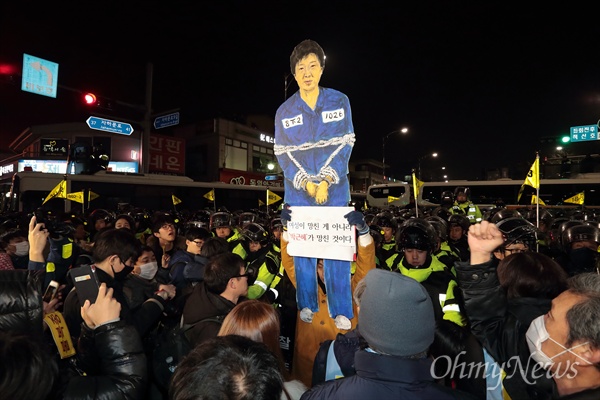
Ms. Park’s silence since the verdict is a slap in the face to every conservative in the country. Three people - people who protested against her impeachment - have died while protesting the Constitutional Court’s decision. Her supporters also attacked journalists for simply doing their job. She should have issued a statement renouncing violence. She should have urged calm. And she should have publicly announced that she, and everyone else, would accept the Court’s ruling - just like she said President Roh Moo-hyun should accept the Court’s ruling when he was impeached - regardless of the decision. Her silence is a betrayal of her supporters and the rule of law. It is indecent and a perfect example of how a leader ought not to behave. It was her final insult to anyone who had ever voted for her.

Image Source

That being said, unlike many people, I don’t take any joy in her impeachment. All I see is tragedy. Her political career lasted for 18 years and the Queen of Elections had every reason in the world to become a great leader - to exonerate her father’s legacy, to squash once and for all the accusations that she and her cronies are corrupt power-lusters, to prove that conservative values could help to lead Korea into the 21st century. She failed completely. Her impeachment was a victory for justice and Korea’s young democracy. But I take no joy in seeing her downfall.

As expected, Moon Jae-in is the man to beat in the upcoming presidential election. Anyone who has ever read anything that I had to say about him would know that I utterly despise the man. Donald Trump is already in the White House (another man whom I have nothing but contempt for) and Moon Jae-in will most likely be the next occupant of the Blue House. A toxic shit storm is brewing; and Kim Jong Un, the Fat Boy King of the North, laughs.

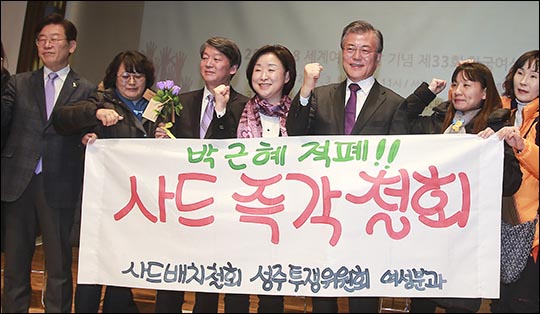
Seeing how he started out by opposing THAAD’s deployment to becoming ambivalent, to seemingly oppose it again, China is likely laughing, too.

This picture was taken on March 8th 2017. It says "Withdraw THAAD immediately."
Image Source

If Moon becomes president and pledges to withdraw the THAAD anti-missile batteries, China will always remember that all it needs to do to convince the South Korean government to do anything is exert just a little economic pressure and it will cave every single time. South Korea’s sovereignty will effectively belong to China. But Moon Jae-in and Choo Mi-ae will be able to say that they stood up to the United States. Never mind that amid Chinese bullying and North Korean aggression and Japanese rising militarism, South Korea’s only friend is the United States!

In short, South Korea’s dark days are not behind it. Things are going to get much darker yet.

Friday, December 9, 2016

President Park Geun-hye has been Impeached!

200 votes were needed to impeach President Park Geun-hye. 234 members of the National Assembly voted to impeach President Park Geun-hye.

For the second time in South Korea’s short history, the National Assembly has moved to impeach a sitting president. Until the Constitutional Court gives its voice on whether or not to approve the motion, the Prime Minister will serve as acting president.

If the Constitutional Court approves the motion, it would be the beginning of a new day in South Korea’s democracy. It would be the first time that a sitting president has been lawfully and democratically removed from office - the first peaceful and legal revocation of power. Considering the mounting evidence that are being stacked against President Park Geun-hye, Choi Soon-sil, and corporate leaders, there is a very good chance that the Constitutional Court will agree that impeachment is warranted.

However, this was never just about Park Geun-hye or Choi Soon-sil. This scandal, this impeachment - everything that we have seen for the past month and a half has been far more than just the removal of a president and shadow president. It has been about government power and the corruption that surrounds it. It has been a popular movement to bring about accountability. This is a new day for South Korea
’s democracy.

It would be a mistake, however, to assume that rhetoric about justice is where this story will end. Politics will rear its ugly head before too long. In fact, I’ll give it less than a day before it does.

The people’s mood has soured against anyone who has ever been associated with the Saenuri Party. It wouldn’t matter if there was anyone competent or intelligent or who possessed integrity from that party. For now, no one from that party is going to fare well with the people. As a result, the party will be dissolved and be replaced with something else. For now, it’s the Minjoo Party’s time to shine.

When they take over the reins of government, the Park administration’s decision to deploy THAAD missile batteries might be overturned. Relations with Japan may worsen by revisiting the comfort women agreement and canceling the military intelligence-sharing deal. Decisions may be made to once again pour aid toward North Korea. No effort must be spared to fight the next government’s foolish decisions.

But politics can resume tomorrow. For now, we can all catch a breath and celebrate democracy.

대한민국 만세!

Image Source

Thursday, October 13, 2016

Private Think Tanks Are NOT Ruining Policy-Making in South Korea

Yesterday, Emanuel Pastreich published a column/op-ed in Korea Exposé, which was titled “Tanks of Destruction: Private Think Tanks Are Ruining Policy-Making in South Korea.”

I don’t know if Pastreich came up with the title himself, or if it was created by the site’s editor and founder, Se-Woong Koo. Either way, it was a catchy title and it caught my attention. And not for the first time, I disagreed with yet another op-ed that was posted on that website.


Basically, Pastreich’s point was that a lot of think tanks in Korea, particularly the mainstream ones, are not worthy of the prestige they possess. The following are a summary of Pastreich’s main complaints regarding think tanks:
  • Much of the content produced by think tanks are banal, dishonest, superficial and ritualistic.
  • Think tanks are ranked according to the amount of funding received, but such funding means they are not independent as think tanks cannot risk upsetting their patrons.
  • Think tanks are not accessible to the public and they represent the interests of a small group who fund the think tanks.
  • Think tanks seek to privatize the work that should be carried out by a government official, a staff member of a government research institute or a professor at a university and set long-term national agenda. But think tanks’ purposes are short-terms gains.
Rubbish Thinking
Image Source

One could say that Pastreich may be throwing stones while living in a glass house. After all, he is the director of The Asia Institute, which is also a think tank. However, I must confess that I am not at all familiar with The Asia Institute or the work that it has produced. So that’s neither here nor there.

Regardless of that fact, however, the fact that he is the director of a different think tank and the other think tanks that he excoriated are basically his competitors is, I think, the weakest rebuttal that can be summoned against Pastreich’s points.

My first point of contention after reading Pastreich’s op-ed was that think tanks are supposed to be exclusive. They are supposed to represent the opinions, thoughts, and research by the elites who have spent a long time studying those subjects they pontificate on.

Back in early 2014, right about the time when Ahn Cheol-soo had just started to seriously begin his foray into politics, one of the first things he did was to establish his own think tank - the oddly-named Policy Network Tomorrow (정책네트워크 내일). I looked at his think tank’s mission statement and it sounded a lot like the kind of think tank that Pastreich is looking for (at least in think tanks that he is not a part of) - a think tank that is accessible to the public and one that doesn’t put too much focus on the “banal and dishonest” experts, but rather, in the words of Policy Network Tomorrow, on “the problems that the people face in their lives.”

I wrote about Ahn Cheol-soo’s think tank before and the unfortunate reality seems to be that if Pastreich’s suggestions regarding accessibility is given serious consideration, it would lead to think tanks that don’t do a lot of thinking.

Pastreich is not wrong when he argued that the opinions and research data that think tanks advocate can be (and often are) hijacked by people with vested interests. That is not in dispute. But the notion that think tanks are supposed to be open to the public or somehow responsive to what the public thinks is wrong. For one thing, all you need to do is speak to one of the unwashed masses who has never thought much about a given topic to know that you shouldn't pay attention to everyone. After all, the direct result of paying too much attention to the opinions of the masses is the rise of Donald Trump!

Besides, if we are looking for people who will better reflect the wishes of the public, those people already exist. They
re called elected officials. I wont hold my breath waiting for people to shower them with glory and praise.

Obligatory mention of the fact that he also said “Democracy is the worst form of government, except for all the others.
Image Source


Another point that I strongly disagreed with Pastreich was his opinion that massive corporate funding makes a think tank less trustworthy and reliable.

There was a think tank that I really liked. It was Freedom Factory, a libertarian think tank that advocated limited government and free market solutions to many of society’s ills.

(Disclaimer: I was never formally employed by Freedom Factory, but I did a number of freelance work for them - mostly Korean-to-English translation services. I also edited their English-language biweekly online news magazine, Freedom Voice.)

Did you notice the use of past tense? That
s because Freedom Factory went out of business a couple of months ago. I recognize that “capitalism” is often used as an epithet and there are even fewer fans of libertarianism. So I understand that some of you may disagree with what Freedom Factory stood for and argue til youre blue in the face that it was evil or throw whatever epithets you can think of. I won’t argue; this post is not meant to serve as a defense of libertarianism.

(And in case any of you are wondering, no, I have never thought of myself as a libertarian. I think of myself as an ally to libertarians, but never one of them.)

However, no matter what kinds of clever curses you can throw at it, it doesn
t change the fact that Freedom Factory produced a good number of studies, surveys, op-ed pieces, translations, media appearances, and helped to spread awareness of the problems of over-regulating businesses and the history of the South Korean economy to the masses. It was a great think tank that saw a great vision for itself. But it went out of business because it couldnt turn a profit.

Pastreich can argue that corporate funding makes think tanks less independent, but not having enough money means that you go out of business. I wish Freedom Factory had the luxury of worrying about a lack of independence. It never even got that chance.

Though I don’t know for certain, I imagine there are many think tanks of various political affiliations that have met and will continue to meet a similar fate.


Regardless of how much people think of the corrupting nature of money, it doesn’t change the fact that corporate funding helps think tanks to do their work. It may not be a perfect solution, but its the best there is. Why is it the best? It’s the best because, going back to my earlier point, the vast majority of the unwashed masses have never even heard of many of the subjects a lot of think tanks and their employees have dedicated themselves to studying; and they dont care for them.

If you think money is the root of all evil, try not having enough of it.
Image Source

The last thing about Pastreich’s op-ed I disagreed with was his argument that think tanks undermine the work that is better done by government officials, government research institutes, and professors at universities. He says that unlike government institutions, think tanks seek short-term gains and this is particularly dangerous when we think about long-term problems such as North Korea.

It
s a wonderful thought that government leaders and bureaucrats are more dedicated to long-term goals than think tanks. Unfortunately, however, reality says otherwise. Case in point, South Koreas policy toward North Korea has changed from administration to administration. Whereas Kim Dae-jung (and Roh Moo-hyun) sought engagement with the North via the Sunshine Policy, Lee Myung-bak immediately pursued a hawkish policy. Park Geun-hye wasn’t nearly as hawkish as Lee Myung-bak (at least initially) or as dovish as Kim Dae-jung as she was an advocate of trustpolitik” during the early days of her administration and she only became hawkish after North Korea’s fifth nuclear test.

If you read any of my columns at NK News, it won’t take you long to know what I think is the proper way of dealing with North Korea. Again, however, this post is not meant to defend or attack one idea or another. The point is that the notion that government officials are somehow more dedicated to pursuing long-term goals than people in the private sector is utter nonsense. It is a praise that government officials and their research institutes clearly do not deserve.

(Whether this is a virtue or a vice of the democratic process is another matter entirely.)

In fact, the only things that the government has insisted on taking the long-term view, regardless of who has been 
in charge, are looking out for their own interests. Even the country’s progressive leaders never abolished the National Security Law or hesitated from using defamation laws to silence their critics in the media.

Also, is there anyone who can say with a straight face that professors are any more virtuous than those who work at think tanks? At the end of the day, to one degree or another, everyone is a whore. The only thing that’s different is whom he sells his soul to and for how much and how happily he does so.

One thing that Pastreich does get right is his comparison of think tanks to hagwons, though certainly not for the reasons he stated. The comparison is valid because, like the hagwon industry, the ideas that are espoused by many think tanks do not seem that different from each other and there does appear to be a strong herd mentality that is defined by an unhealthy dose of 
“follow the leader mentality. There does need to be an infusion of new ideas (not that being new by itself is a virtue) and healthy debate among think tanks and universities and government research institutes. That is how we make sure that we do not fall victims to our own filth.

So, yes, there is a feeling of staleness when it comes to private think tanks in Korea. But are they ruining policy-making? That hardly seems to be the case. Although some of Pastreich’s criticisms may be valid, he does not seem to have really thought through on the subject of private think tanks as much as he seems to think he has.

Monday, March 23, 2015

Grieving Lee Kuan Yew's Passing

I go through the news at least twice a day every day. For those who frequent this blog, I am sure that it will not surprise you when I say that I have tailored my newsfeed to focus on news stories that are focused on business, finance, and economics.

However, I saw a news story pop up the other day, the kind that doesn't usually appear on my newsfeed, which grabbed my attention.

It was a headline from The Wall Street JournalSingapore Former Prime Minister Lee Kuan Yew’s Condition Worsens.

At age 91, Lee Kuan Yew has certainly lived a long life, and it is only natural that sooner or later, death comes for saints and sinners alike. And just this morning, I saw that he has finally passed away. No one lives forever, and though his passing was expected, I still feel a deep sense of sadness knowing that he is gone.

I was fifteen years old when I first read Alex Josey's book Lee Kuan Yew: The Critical Years (1971-1978) in my school's library. As I read about the political challenges that Lee Kuan Yew had to face – striving to have Singapore become accepted and then eventually being expelled from the Malaysian Federation, the conflict with the communists, the delicate balancing act that was needed to ensure Singapore's multicultural population did not devolve into ethnic strife, the establishment of an institutional and legal order that were needed to transform Singapore from a former backwater colony to a developed nation – my respect and admiration for him knew no bounds.

Image Source

It was right around the time when the conflagration that came to be known as the Asian Economic Crisis engulfed so many lives when I first read about Lee Kuan Yew. Although Brunei, the country where I was living at the time, was not considered as one of the countries that was directly affected by the crisis, when the indirect effects of the crisis merged with Brunei's own internal problems at the time  which involved a playboy prince who had misspent billions of the country's money to maintain a hedonist lifestyle (see here, here, here, and here– Brunei's economy went into a tailspin.

As I compared him to other Asian leaders who were in power at the time, many of them now disgraced and/or forgotten, I felt bitterly angry that there wasn't anyone else who possessed the determination, the vision, the self-confidence, and the intelligence that Lee Kuan Yew possessed. I thought that Lee Kuan Yew was a giant among men and that he was the kind of leader that Park Chung-hee could have been; the kind of leader that world leaders ought to emulate.

Then for many years after that, I had stopped thinking of Lee Kuan Yew, until now. The simple reason for it was that despite the ravaging effects of the Asian Economic Crisis and Amadeo's implosion, life still went on. I went on to graduate from high school, went on to college and then graduated from college as well, learned and experienced new things, gotten jobs, quit jobs, paid bills, accumulated debt, went through personal hardships, overcame some of them, and learned to adapt to those that I could not overcome. Life has a way of moving on, it seems, and making us forget even things that we once held most dear.

As the years passed by, after being influenced by Milton Friedman's eloquent arguments for economic freedom, Friedrich Hayek's seminal book The Road to Serfdom, and Ayn Rand's philosophy of Objectivism, my views changed dramatically. And I stopped believing that Lee Kuan Yew was the kind of leader that others ought to emulate.

I rejected Lee Kuan Yew's tribal notion of “Asian Values” – the implication that “Western-style” democracy is somehow not applicable to Asian nations because of the particular sets of culture that Asians are born and raised in. I rejected the notion that culture determines an entire people's societal structure into perpetuity.

Image Source

The United States' military adventures in Iraq and Afghanistan and its subsequent failures to “impose democracy” on those societies might have somewhat exonerated Lee Kuan Yew's belief that cultural differences could cause an imposition of democracy on those societies to become a failure.

However, comparing Asian countries – such as South Korea, Japan, Taiwan, Hong Kong, and Singapore, which have developed their economies, social structures, and their political values since the 1950s – to Iraq which had been ruled by a fascist dictator and to Afghanistan that had been ruled by the Taliban for decades is a clear attempt at academic dishonesty. As the former countries' economies transformed from labor-intensive economies to capital-intensive economies to technology-intensive economies, people's priorities, thoughts, beliefs, and political views have changed.

The idea that people's culture is static is wrong. And it is clear that Lee Kuan Yew could not have failed to have known that. In other words, his notion of Asian Values” was no more than a bald-faced attempt at retaining his own hold on power.

I also rejected Lee Kuan Yew's reliance on Orwellian social engineering programs and Machiavellian politics to curtail social vices that range from chewing bubble gum to caning people for drug-related charges. His use of the Internal Security Act, Singapore's version of Korea's National Security Act, as well as his penchant for bankrupting his political opponents (see here, here, and here), which effectively banned them from participating in politics due to the country's Bankruptcy Laws, was just as abusive, if not more so.

I also found it hypocritical that his government intruded so much into Singaporeans' daily lives despite his proclaimed belief that “the ruler or the government does not try to provide for a person what the family best provides.” The extent that is Singapore's Nanny State is especially glaring considering the fact that over 80% of the Singaporean population lives in public housing.

Image Source

However, Lee Kuan Yew's most lasting legacy, which will last into the future long after he is gone, is that he was the intellectual voice behind the foisting of authoritarian capitalism. He succeeded where Park Chung-hee failed. Unsurprisingly, Singapore has long been China's source of inspiration in its plans to develop its political structure as well as its socio-economic engineering programs (see here, here, here, and here).

Considering China's economic might, it is possible that the authoritarian capitalism that Lee Kuan Yew advocated and championed will define the twenty-first century as much as liberal capitalism defined the twentieth century, which would seemingly nullify Francis Fukuyama's theories in his book, The End of History. If Lee Kuan Yew's version of capitalism replaces the liberal form of capitalism in much of the world's zeitgeist, which I think it could, the social changes it could bring to the world will be enormous, in both good and terrible ways.

It has been many years since I thought that Lee Kuan Yew was the kind of leader that world leaders ought to emulate. As I said earlier, I stopped believing that a long time ago. Now, I have lost all faith in the benefits of concentrated political power even if it is in the hands of wise and benevolent leaders of whom I know none.

Although I now stand firmly against many things that Lee Kuan Yew stood for despite my youthful dalliances with authoritarianism, I am still grieving now that Lee Kuan Yew has breathed his last. Although I have come to stand opposed to his leadership style and philosophy, and dearly hope that his legacy will not be as widespread as I fear it will be, what no one can deny is that he was still an intellectual giant among men who had achieved more than most can even dream. Though perhaps not goodness, he has certainly achieved greatness and immortality in his own right. As Richard Nixon once said, had Lee Kuan Yew “lived in another time and another place, he might have attained the world stature of a Churchill, a Disraeli, or a Gladstone.”

Though I am grieving his passing, I do not grieve the authoritarian that he became. Rather, I am grieving the man that he could have been – an intellectual titan who might have attained the world stature of a Locke, a Jefferson, or a Tocqueville – a man who, above all else, might have used his staggering and formidable intelligence to champion the cause of freedom and liberty.

Unless you are on your deathbed
Image Source